Category Archives: General

Geodesics

What’s the shortest way to travel from London Heathrow airport (LHR) to JFK International airport (JFK)?

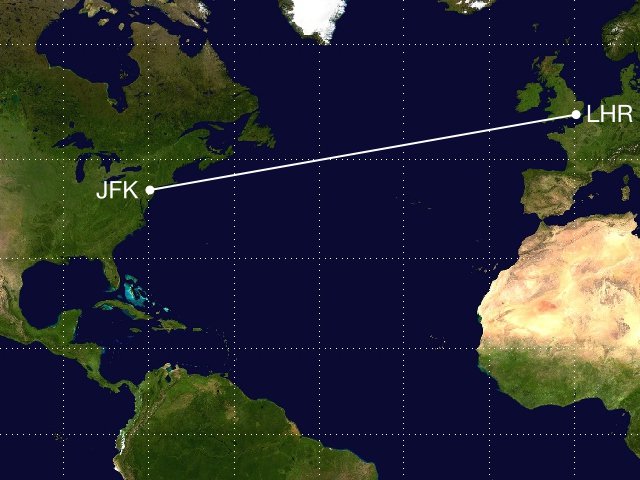
You’d think it would be a straight line like this:

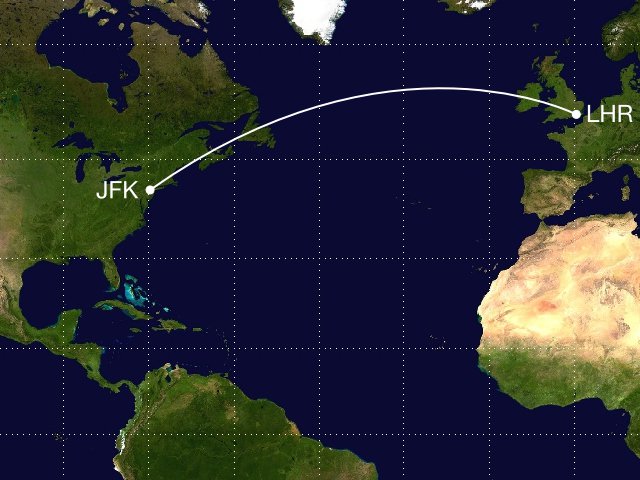
But you’d be wrong. The shortest distance between LHR and JFK is actually a curve:

This is because the “shortest distance between two points is a straight line” rule only applies to a flat surface: normally when you use a map it covers such a small area that the curvature of the Earth isn’t noticeable, but on a map of the world it becomes important.

Because a map takes the curved spherical surface of the Earth and maps it onto a flat surface no map can accurately show the whole world – every possible map projection is cursed to distort the size and/or shape of countries and their location relative to each other. The only accurate representation is a true globe. The surface of the Earth is non-Euclidean and thus the rules of geometry that you’re used to don’t apply: parallel lines will eventually meet (e.g. lines of longitude meeting at the poles) and the angles inside a triangle can add up to more than 180°.

The shortest distance between two points, regardless of geometry is called a geodesic: on  flat 2-dimensional planes geodesics are straight lines and on the surface of 3-dimensional spheres geodesics are curved.

Estimating energy usage and savings

There’s a fascinating paper in this week’s Proceedings of the National Academy of Sciences of the United States of America (PNAS) journal about people’s perceptions of the energy used and saved by various devices and methods.

The researchers’ conclusions are not good news, especially in the light of the energy savings that are required to reduce anthropogenic climate change:

“[P]articipants in this study exhibited relatively little knowledge regarding the comparitive energy use and potential savings related to different behaviours … [they] were also … unaware of differences for some large-scale economic activities … and everyday items.”

The researchers recruited 505 volunteers using Craigslist (which must introduce an interesting set of biases) and asked them to estimate the amount of energy used by various household devices, and to estimate the amount of energy saved by various methods.

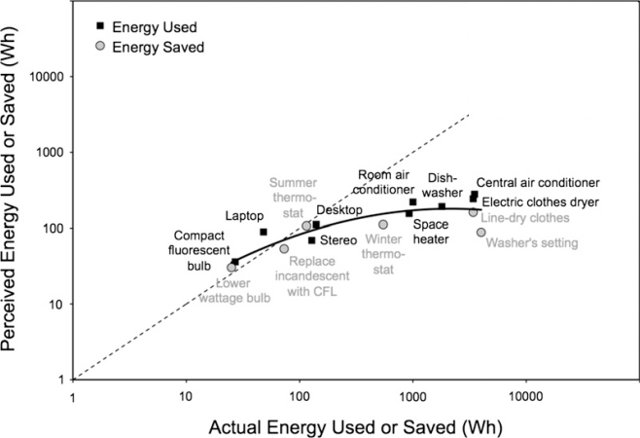
On average the study’s participants underestimated the energy used or saved by a factor of 2.8; people estimate that a device using 1000 watts of electrical power actually only uses 350W and a method that saves 500W would be estimated to save only 180W.

Participants did understand that energy savings were possible, but underestimated the size of the saving. For example, participants knew that a laptop computer used less power than a desktop computer, but thought that the saving was less (23W) than it actually was (92W). The more energy a device/method used or saved, the less accurate participants were. Participants estimated that transporting goods by truck used about the same amount of energy as transporting by train or ship, despite the fact that trucks actually use ten times as much energy: they overestimated the use of energy by ships and trains and underestimated trucks and aeroplanes.

In this graph from the paper overestimates appear above the dashed line and underestimates below.

The activity most commonly selected in answer to a question about the single most effective thing participants could do to save energy was “turn off lights”, whereas in reality resetting the thermostat or washing clothes on a colder setting would save far, far more energy. Far more participants selected “curtailment” activities (e.g. turning off lights, not using the car) as saving more energy than “efficiency” activities (e.g. switching to compact fluorescent lightbulbs) despite the fact that the opposite is most likely correct.*

* See Gardner, G. and Stern, P. (2008) The short list: the most effective actions US households can take to curb climate change, Environment Magazine, 50, pp. 12-24. Link

Liquid metal telescope

As previously mentioned, size matters when it comes to telescopes: the bigger the mirror, the better the telescope (i.e. the greater the resolution and light-gathering capability). The world’s largest single telescope mirrors are the 8.4-metre telescopes used by the Large Binocular Telescope.

Telescope mirrors must be perfectly polished and accurate in shape and size to within a billionth of a metre. This means that making telescope mirrors is extremely difficult and therefore time consuming and very expensive, costing millions of dollars.

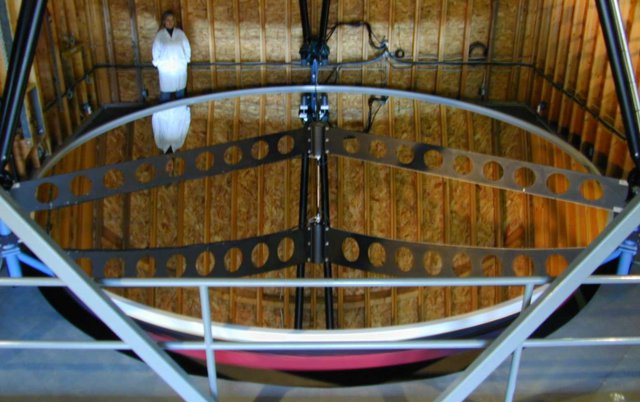
But there is an alternative to polished metal and silvered glass: mercury. Simply filling a pan with liquid mercury will create a perfectly flat* reflective surface; the surface can then be made curved by spinning the pan. No expensive manufacturing is required and this keeps costs low: a liquid mirror costs about 1% of the cost of a similar-sized conventional mirror. (They do have the disadvantage that they can only point upwards, however.)

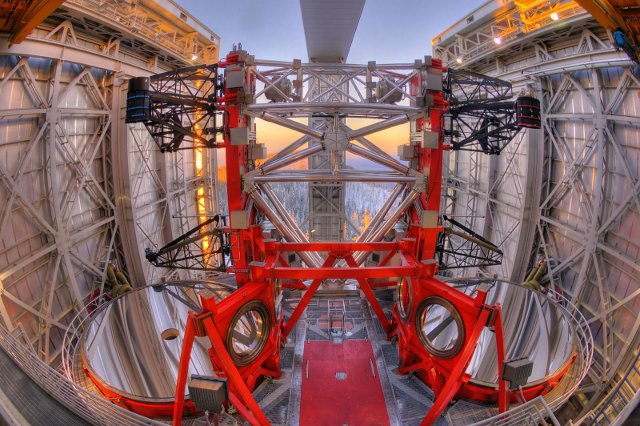
The University of British Columbia’s six-metre Large Zenith Telescope in Vancouver is the world’s largest liquid mirror telescope.

The simplicity of constructing a liquid mirror telescope has even led to suggestions that one should be built on the Moon.

* To give you some idea of how flat a liquid mirror is: if you built a mirror the size of the Earth, the largest bump would be less than a millimetre in height.

Things From Movies That Cannot Exist Number 2: The Magical Shotgun

The Magical Shotgun (and it’s close cousin, The Magical Pistol) is a staple of the over-the-top action movie. The Magical Shotgun will be familiar to anyone who’ve ever watched a John Woo film: a character hit by a shotgun blast is thrown backwards at great speed through the air, usually into a plate glass window.

Unfortunately this just isn’t possible and the Law of the Conservation of Momentum explains why: in any collision, whether it’s a car striking a bus, or buckshot striking our leading man, momentum must be conserved. The total momentum before the collision must equal the total momentum after the collision.

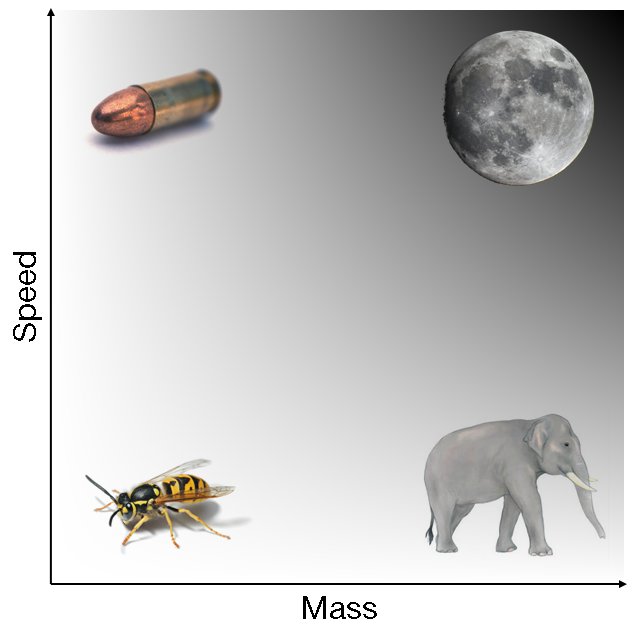
Momentum is the product of mass and speed and can be loosely thought of as indicating how difficult it would be to change the motion of something. The graph below shows how momentum changes – a darker background indicates greater momentum.

The momentum before the collision is the mass of the shot multiplied by its speed: using typical values of 30 grams of shot travelling at 350 metres per second we have a momentum of 10.5 kgm/s. After the collision the momentum is the combined mass of the target plus the shot, multiplied by the speed of the target moving backwards.

If we assume the target is an average-sized man with a mass of 85 kg and that he’s standing still before he gets shot then the combined mass is 85.03 kg, which, with a momentum of 10.5 kgm/s gives us a final speed of 0.12 m/s or twelve centimetres per second (0.27 mph); this bears no relation to what’s seen on film.

How dangerous is it to ride a motorbike?

Statistics from the Office for National Statistics (via the Department of Transport) and the Motor Cycle Industry Association show that (for the year ending December 2009) motorcyclists make up 2.6% of road users, and 21.2% of road deaths.* So how dangerous is it to ride a motorbike?

This is really a question of quantifying risk, and that’s not something we’re very good at. But let’s take a look at the statistics:
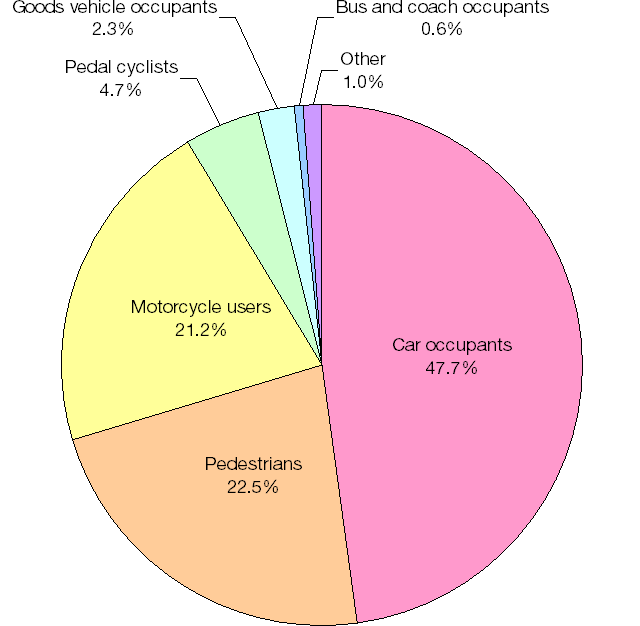
There were 2222 “all road user” deaths in 2009, of which 472 were motorcyclists. If motorcyclists were killed at the same rate as they are present on the road then we would expect only 58 (well, 57.7) of the 2222 dead to be motorcyclists. Can we therefore say that 414 motorcyclists died who “shouldn’t” have died? Can we say that the rate of motorcyclist deaths is 8.14 times what it “should” be?

Looking at death figures says nothing about the ability or skill of motorcyclists. Some would argue that the majority of motorcyclists are killed by the poor driving of car users and not by their own poor driving; but this does not alter the fact that it is the motorcyclists who die.

How likely are you to die on the road?

85.9 people are killed or seriously injured on the UK’s roads per billion motor vehicle miles. That means that if you drove a billion miles (more than eleven times the distance from Earth to the Sun) in one vehicle you would expect 85.9 deaths (or serious injuries) to occur. To put that in more manageable terms, if you drove the UK average of 8000 miles per year you could expect to kill or injure 0.000687 people (per year). To kill or seriously injure one person you would either have to drive 8000 miles per year for 1455 years, three months, five days, twenty hours, forty minutes and thirty-one seconds; or drive 11 641 444 miles per year.

If you started driving at midnight on the morning of 1st January of zero AD you could expect to kill or seriously injure someone (or yourself) by twenty to nine on the evening of 5th March 1455, a month or so before Pope Calixtus III takes over from Pope Nicholas V as the 209th pope (the current pope, Benedict XVI, is the 265th). If you decided to drive the eleven million miles in one year that would require an average speed of 1329 miles per hour, nearly two and a half times the speed of sound.

Whichever way you look at it, you’re pretty unlikely to die on the roads.

But more likely if you’re on a motorbike.

* Doing research for this post I also discovered that in 2008 the DVLA licensed 319 “lifeboat haulage vehicles”, nineteen “mine rescue vehicles” and three “digging machines”.