Category Archives: General

Naming element 114

Element 114 was first created at the Joint Institute for Nuclear Research in Dubna, 120km north of Moscow, by bombarding plutonium-244 with ions of calcium-48. This created an unstable atom of element 114 (indicated by the asterisk) which then decayed into a different isotope of element 114 and three neutrons:

Unq

But what is that symbol – “Unq”? Unq is the current chemical symbol for element 114, known at the moment by its systematic name, ununquadium (“un” – one, “quad” four).

Now that the work by the JINR has been verified by work at the US Berkeley Lab and German GSI laboratory, the International Union of Pure and Applied Chemistry (IUPAC) will invite the researchers from Dubna to submit a “proper” name; this name will then be scrutinised for six months before being approved or disapproved.

Scientists at the Dubna laboratory are already responsible for naming element 102 “nobelium” and element 105 “dubnium” (there was some controversy over this). According to the rules, the discover may not submit a name that has already been proposed for another element so both “kurchatovium” (which Dubna proposed for element 104, after Igor Kurchatov) and “nielsbohrium” (which they proposed for element 105) are out. (Niels Bohr was later honoured by the naming of element 107 “bohrium”.)
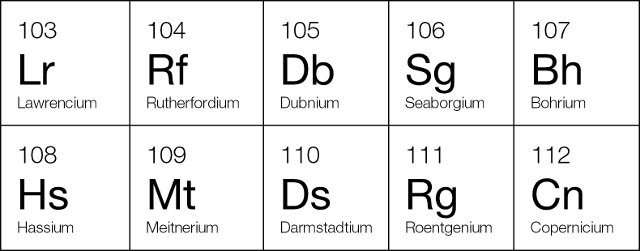
Of the ten heaviest named elements, seven are named after people (copernicium, roentgenium, meitnerium, bohrium, seaborgium, rutherfordium and lawrencium) and three are named after places (darmstadtium, hassium and dubnium). Seaborgium is unique in that it is the only element to have been named after someone who was alive at the time of naming.*

Readers at The Guardian have suggested atlantium and salubrium as names, whilst commenters on a post at Physics World (a better crowd, of course) have suggested fibonaccium, darwinium and diracium. What do you think? What should element 114 be called?

* The discovery of einsteinium and fermium (by a team that included Seaborg) was kept secret during the Cold War and thus their names did not become known to the public until after both Einstein and Fermi had died.
My favourite “proof”

I have a favourite question in physics:

“Why do things get darker when they get wet?”

This is my favourite question because the proof is so brilliantly simple, and easy to demonstrate.

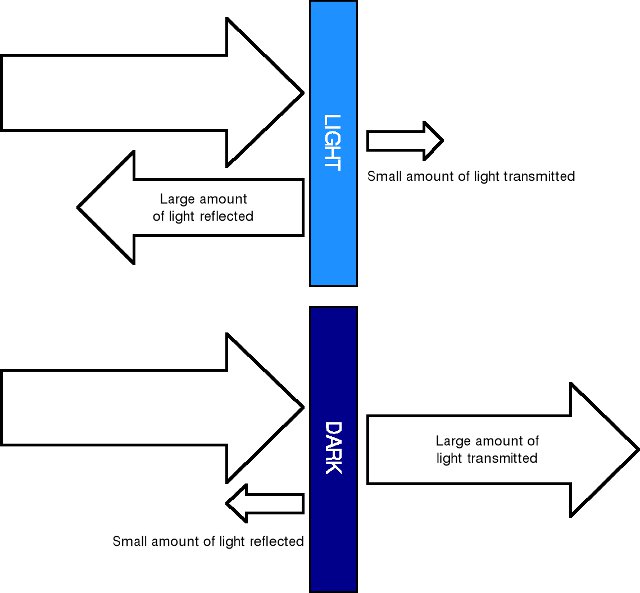
Objects appear darker when wet because more light passes through them. Brightness is a measure of how much light is reflected to your eyes, and if less light is reflected then more light must be being transmitted through the material (or absorbed).

When wet, water fills in the “gaps” in the material, “channeling” light through it to the other side.

You can prove this is the case by holding a wet piece of material up to the light – it appears brighter than the surrounding material because more light passes through the material to your eyes.

Things From Movies That Cannot Exist Number 1: The Grapple Gun

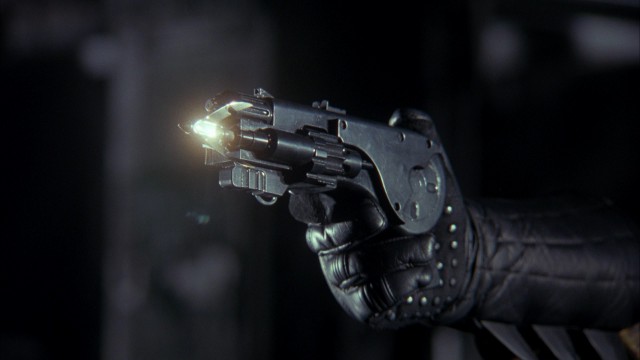
The grapple gun is a staple of the action movie genre: simply point the hook skywards, fire and have the gun lift you onto the roof of your local Abandoned Warehouse™ or Deserted Chemical Plant™. The Batman is particularly fond of the Grapple Gun, making it a staple of his famous Utility Belt.

So let’s look at the physics:

Assuming The Batman is a well-built adult male and that he’s wearing a substantial amount of body armour and equipment, a mass of 150kg is probably reasonable. Raising a 150kg weight to the top of a ten storey (30m) building requires about 45,000 joules of energy (45 kJ). If The Batman takes thirty seconds to do the journey then that is equivalent to a power of 1500 W. A motor capable of lifting The Batman’s 150 kg weight is probably about 75% efficient, meaning the motor has to develop about 2000 W.

If we assume that the grapple gun’s motor is no more than 5 kg in mass (for ease of wielding) that gives a power-to-weight ratio* of 400 W/kg. This is within the capabilities of modern electric motors, but only just. Finding a battery that can provide 45 kJ is not difficult; lithium ion batteries can provide about 600 kJ per kilogram. However, they can’t supply that electricity quickly enough, managing only about 300 W/kg which means that the Grapple Gun’s 5 kg motor is going to come with a substantial 5kg battery to match. Then there’s the weight of the gun itself and the super-strong cable to consider …

Whilst devices for firing grappling hooks do exist (I’m told the Battelle Tactical Air Initiated Launch system is good) and powerful electric motors are fairly common, merging the two to create a useful handheld device is beyond the capabilities of physics at the moment. A real grapple gun would be far too bulky, heavy and unwieldy to be of any practical use.

* Of course this should really be power-to-mass ratio, but I’m going to stick with the more commonly used term.

Rods from God

The problem with bombs is getting them to their target. Dropping them from the air has always been the standard approach (Austrians used air-dropped bombs during the siege of Vienna in 1849), but this is beset by problems. Even stealth aircraft like the B-2 Spirit stealth bomber and the F-22 Raptor stealth fighter are not perfect.

The Rods from God idea did away with aircraft, and with explosives altogether. The concept is very simple: a series of satellites orbit Earth armed with “tungsten telephone poles”. Once a target has been selected and the satellite is overhead, the “pole” is released and pushed towards Earth by a small rocket motor. As the pole falls to Earth from space it requires no fuel; it is powered by gravity alone.

With such a large distance to fall the rod has plenty of time to accelerate, even when the effect of air resistance is taken into account. Hitting the ground at more than ten thousand metres per second (more than 24000 mph) the rod would be able to strike targets buried deep underground.

With a mass of more than eight and a half tonnes, a rod travelling at that speed would have an energy density of fifty million joules per kilogram, far more than TNT (4.6 million joules per kilogram) or nitroglycerin (6.4 MJ/kg). With very little warning of incoming attacks, the weapon’s speed would make it almost impossible to defend against.

Fortunately (or unfortunately, depending on your viewpoint) the Rods from God (or “kinetic bombardment”) system has yet to be deployed. The most recent mention was in a 2003 US Air Force report (PDF) that classified “hypervelocity rod bundles” as a “Post-2015” technology.

Uranium-233 and the thorium future

When people think of nuclear fuel they tend to think of uranium and plutnonium, or more specifically their fissile isotopes: uranium-235, plutonium-239 and plutonium-241. But there is another fissile isotope that doesn’t get the attention it deserves: uranium-233.

A fissile isotope is one that can sustain a nuclear chain reaction. There is only one naturally-occurring fissile isotope: U-235 which makes up 0.7% of mined uranium (the other 99.3% being non-fissile U-238). Plutonium-239 and -241 are both “bred”, created artificially in a reactor: Pu-239 from the inert U-238 and Pu-241 from Pu-240 which is itself bred from Pu-239.

Making plutonium-239:

In the first stage U-238 is bombarded with neutrons (n) to create U-239. This U-239 then undergoes beta decay* to form neptunium-239:

This neptunium then undergoes a second beta decay to form Pu-239:

Making plutonium-241:

To create plutonium-241 the plutonium-239 from the previous step is bombarded with neutrons to form first Pu-240 and then Pu-241.

Breeding uranium-233 from thorium:

Uranium-233 is produced by bombarding thorium-232 with neutrons to create Th-233 which then undergoes two beta decays to form U-233. This can all be done inside the reactor itself.

Using thorium as a nuclear fuel has a number of significant advantages: it is made up of only one isotope which means that no costly (in both financial and energy terms) enrichment processes are necessary and thorium is at least four to five times more abundant in Earth’s crust than uranium.

Thorium can be used in a molten salt reactor, where it is dissolved into uranium fluoride to form a fluid that is both fuel and coolant (the full name of this reactor is the liquid fluoride thorium reactor). The advantage of using molten thorium as both fuel and coolant is that the reactor then has passive (“fail-safe”) safety: if the fuel begins to overheat then the reaction rate decreases, making a meltdown impossible.

The reaction takes place at a pressure of one atmosphere, meaning no pressure containment vessels are needed. Thorium reactors produce far less waste than uranium reactors do, and the waste produced is far safer: after 10 years 83% of the waste can be sold to recyclers and reused.

More information:

* Completists will notice that I’ve missed out the electron antineutrinos produced in beta decay; I’ve removed them for simplicity since they don’t really play a role here.