Category Archives: General

The loudest sound

Sound is created by vibrating objects. As an object, such as a loudspeaker’s diaphragm moves back and forth it compresses the air, causing changes in pressure. These changes in pressure cause your eardrum to move back and forth and these back-and-forth movements are translated by your brain into sound. Larger, louder, movements cause greater changes in pressure.

A tuning fork creates compressions (higher pressures) and rarefactions (lower pressures) in the air.

The human ear is incredibly good at detecting changes in air pressure; it can detect the greatest range of stimuli of all your senses. The quietest sound that the ear can hear is the smallest change in pressure that it can detect: 20 µPa, less than a billionth of atmospheric pressure. To calculate the volume of a sound you must compare the pressure change caused by the sound with this smallest detectable change.
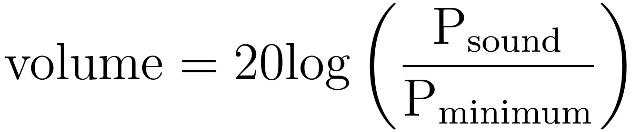
The decibel* scale is logarithmic. One bel represents a tenfold increase in pressure so a 50 dB sound is ten times louder than a 40 dB sound. The average volume of human speech is about 60 dB and the threshold of ear pain is 130 dB, some 107 or ten million times louder.

Because a sound wave consists of alternating low and high pressures there comes a point at which the sound is so loud that the rarefaction (low) pressure is the lowest possible pressure: a vacuum at 0 Pa. This corresponds to a compression pressure of one atmosphere or 101325 Pa. If we put these figures into the equation for volume we find:

So there you have it: the loudest possible sound is 194 dB. It has often been said that the loudest ever recorded sound was the eruption of Krakatoa in 1883 which was heard from nearly 5000 km away. The pressure wave created by the eruption was measured to be at least 20000 Pa, equi­valent to a volume of 180 dB, 101.4 or twenty-five times quieter than the loudest possible sound.

* The prefix deci- indicates a tenth.

Colour blindness

Following on from an earlier post about the human eye’s inability to see the colour blue in detail, I’m taking a look at colour blindness.

I’ll be using this test image of a forest and rainbow throughout.


The two most common types of colour blindness both occur in the red-yellow-green part of the colour spectrum and are commonly referred to as red-green colourblindness, because sufferers cannot distinguish between the two colours. In both cases red and green appear yellow (i.e. as a combination of red + green = yellow).

An inability to perceive the colour red is called protanopia and occurs in some form in about 2% of males and 0.01% of females.

An inability to perceive the colour green is called deuteranopia and is the most common, occurring in some form in about 7% of males and 0.4% of females.

Protanopia and deuteranopia are very similar, but there is a subtle difference between the two if you look very carefully. The difference is easier to see in the animation below that flicks back and forth between the two.

The reason that protanopia and deuteranopia are more common in males than females is that colour blindness is most commonly inherited from a gene on the X chromosome. Men (XY) have a much higher risk than women (XX) because the colour-blindness gene is recessive: with two X chromosomes there is a chance that one of the Xs has the normal colour vision gene and that will dominate.

The third form of colour blindness, tritanopia, is much rarer and not sex-linked, because the gene that controls it is carried by chromosome seven which is present in both sexes. It occurs in about 0.01% of the population and results in short wavelength blue light being shifted towards longer, greener wavelengths. If protanopia and deuteranopia are red-green colourblindness then tritanopia could be described as blue-yellow colourblindness.

Best and Worst Jobs 2011

CareerCast has released its 2011 list of the Best and Worst Jobs and scientists and engineers have come out pretty well:

  1. Software Engineer
  2. Mathematician
  3. Actuary
  4. Statistician
  5. Computer Systems Analyst
  6. Meteorologist
  7. Biologist
  8. Historian
  9. Audiologist
  10. Dental Hygenist

Within the top 50 and bottom 50 jobs, if you sort jobs by salary you get a slightly different list with an even better outlook for scientists:

  1. Pharmacist ($109k)
  2. Petroleum Engineer ($109k)
  3. Physicist ($106k)
  4. Astronomer ($105k)
  5. Financial Planner ($101k)
  6. Nuclear Engineer ($97k)
  7. Optometrist ($96k)
  8. Aerospace Engineer ($95k)
  9. Mathematician ($94k)
  10. Economist ($87k)

Jobs were ranked in terms of income, the physical and emotional environment experienced, the physical demands of the job and the outlook for the future in terms of employment and income growth.

Advances in antennae

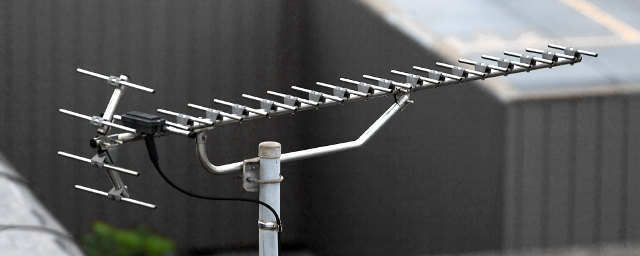
An antenna is a device for sending or receiving radio signals. You’re probably most familiar with the Yagi-Uda antennae used for receiving UHF terrestrial television signals or the parabolic satellite dishes used to receive Ku-band satellite television signals.

A high-gain Yagi-Uda antennae used for terrestrial digital television.

Warships typically have a large number of antennae but this is problematic: they can be damaged easily and they increase the radar cross-section of the ship, making it easier to detect and target.

The US Navy’s Space and Naval Warfare Systems Command has come up with what they think is a good solution: an antenna made of seawater. Because seawater contains salt it is a good conductor of electricity and can be used in just the same way as metal, with the advantage being that the antenna only exists when needed and is therefore not subject to the problems already mentioned.

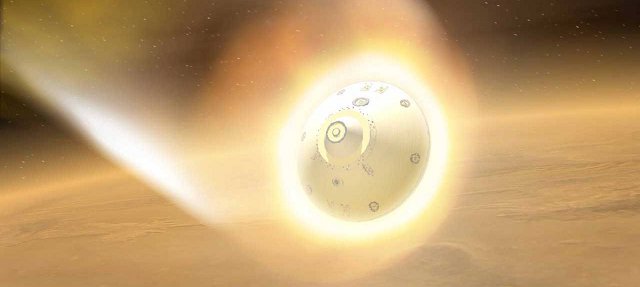
Further away from home, one of the most critical points in a space mission is the reentry phase when the spacecraft enters Earth’s atmosphere. The problem is that during reentry the spacecraft is surrounded by plasma, a superheated gas in which all the electrons have been stripped from their atoms. This plasma sheath absorbs and reflects any signals, making communication with the craft impossible at this critical time.

A group of US and Russian scientists have published a paper in which they suggest a solution that is similar to the water antenna above. The absorption of a signal creates a resonating layer in the plasma, and this layer can effectively become an antenna. By bouncing another signal off this layer from inside or outside the spacecraft it is possible to discern the original signal. The military are likely to be particularly interested in this solution, as it would enable communication with intercontinental ballistic missiles in flight, enabling them to be reprogrammed or disarmed.