Category Archives: General

Orbits

Thanks to my Dad for the inspiration for this post.

Earth is orbited by thousands of artificial satellites (and one natural one). These satellites orbit in a number of different ways according to their purpose.

Low Earth Orbit (LEO)

Examples: International Space Station, Hubble Space Telescope, Iridium communication satellites.

Objects in LEO orbit at between 200 and 2000 kilometres from Earth. The low distance from Earth means that it is relatively easy (in terms of energy/fuel) to get into LEO and this orbit is therefore popular. This popularity is boosted by the fact that devices on Earth’s surface do not need to be high-powered to transmit a signal to the satellite. Objects in LEO orbit the Earth about once every 90 minutes and therefore do not remain fixed over a given location for any length of time, requiring that a constellation of satellites be present to provide continuous coverage of/to any one area. For example, the Iridium satellite phone constellation is composed of sixty-six active satellites orbiting at about 780 kilometres above Earth.

Current position of: ISS and Hubble Space Telescope.

Medium Earth Orbit (MEO)

Examples: Global Positioning System (GPS), GLONASS and Galilieo positioning systems.

Satellites in MEO orbit between 2000 and 35 000 kilometres. At this orbit fewer satellites are required to cover the globe: GPS uses thirty-one satellites orbiting at 2o 200 km; and the Russian equivalent, Glonass, uses twenty-four satellites orbiting at 19 100 km. At this distance devices that communicate with satellites have to be high-powered to reach them, but in the case of navigation satellites, which are transmit only,* this is not a problem.

Current position of: GPS Navstar satellites and GLONASS Cosmos satellites.

Geosynchronous Orbit

Examples: Satellite television broadcasting, weather and reconnaissance satellites.

A geosynchronous orbit is one that is in sync with the rotation of Earth: it takes geosynchronous satellites exactly one day to complete one orbit. If a geosynchronous satellite is placed in the same plane as the equator then that satellite is said to be geostationary – relative to an observer on Earth it remains in the same place in the sky all the time. This means that the antennae used to communicate with geostationary satellites can remain in a fixed position – they do not have to move to track the satellite as it moves across the sky.

The idea of a geostationary satellite was popularised by the science fiction author Arthur C. Clarke in an article for Wireless World magazine entitled Extra-Terrestrial Relays – Can Rocket Stations Give World-wide Radio Coverage? so geostationary orbits are sometimes known as Clarke Orbits.

Calculating the height of a geostationary orbit is relatively simple. Any object moving in a circle requires a centripetal force towards the centre of that circle to keep it moving on a curved path. By setting this centripetal force equal to the force of Earth’s gravity pulling on the satellite and solving to find the radius of the circle you find that geostationary satellites orbit at 35 768 kilometres above Earth.†

Not all geosynchronous orbits are geostationary. A geosynchronous polar orbit, in which the satellite passes over both poles causes the satellite to be above the same location at the same time every day, which is useful in making day-to-day comparisons. When using this system more than one satellite is required because each satellite will spend a large amount of time facing the dark (i.e. non sun-facing) side of the Earth.

Polar Orbit

Examples: Imaging/reconnaissance satellites

A polar orbit is one in which a satellite passes over both of Earth’s geographic poles as it orbits; on each orbit it will therefore be above a strip of land west (as the earth rotates east-to-west) of the piece it previously orbited. Polar orbits like this are useful because a low number of satellites can image the entire Earth. NASA’s MODIS system is composed of two satellites (Terra and Aqua) that image the entire Earth once every one or two days.
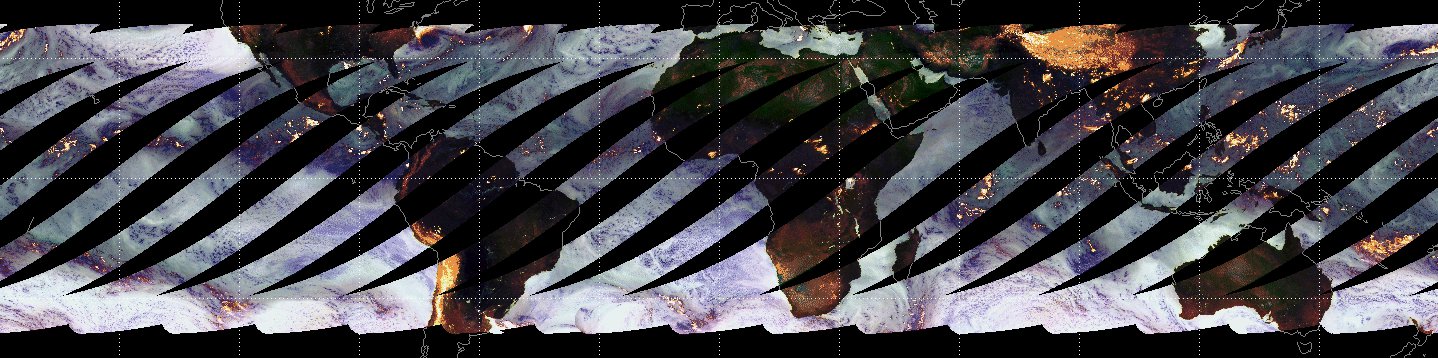
An image showing one day of swaths from the TRMM satellite.

Current position of: TerraAqua and TRMM satellites.

Elliptical Orbits
Examples: Specialised communication satellites, Sirius satellite radio

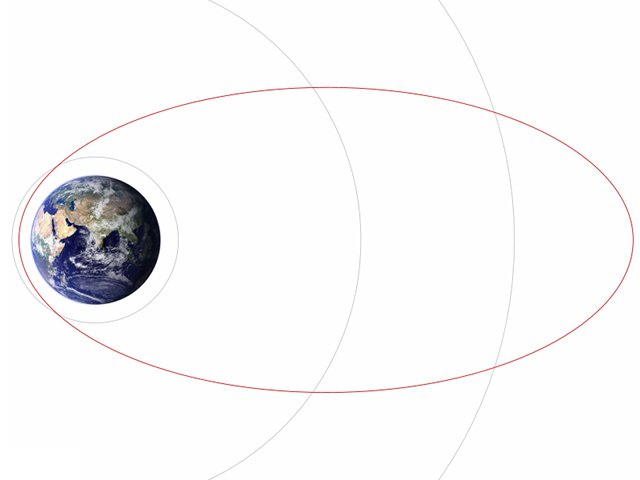
All of the previous orbits are circular, each satellite remains at a constant distance from Earth’s surface. Satellites in elliptical orbits change their distance from Earth, speeding up as they approach closer to Earth and slowing down as they move away. Satellites in elliptical orbits spend long periods of time over one area of Earth, providing coverage of that particular area with a small number of satellites.

A communication satellite in a geostationary orbit is further away from northern latitudes than the equator and therefore requires more power to be able to reach these locations. Russian Molniya communication satellites (after which the Molniya orbit is named) orbit at an angle of 63° to the equator at a distance between 500 and 40 000 km and take half a day to complete one orbit, enabling them to loiter above 55°N for six hours a day, which means that only three satellites are required for all-day coverage at high latitudes (as they can broadcast to 55°N from below this latitude). The Sirius Satellite Radio system, which broadcasts to North America, uses three satellites in Tundra orbits which are similar to Molniya orbits in their inclination and eccentricity, but with an orbital period of one day, making them geosynchronous. In contrast, the XM satellite radio system uses two satellites placed in geostationary orbits at longitudes of 85°W and 115°W (corresponding approximately to the west and east coasts of the USA).

Graveyard Orbit

Graveyard orbits are where satellites go to die. At the end of their useful life, if there isn’t enough energy to push a satellite into Earth’s atmosphere where it will burn up (or land in the “spacecraft cemetery” in the Southern Pacific Ocean off the coast of New Zealand) then satellites are pushed into an orbit above their normal location so that they do not collide with active satellites in their original orbit.

An image of space debris from the European Space Agency.

You can use WolframAlpha to find out which satellites are currently above your location.

* The US Department of Defense, which runs the GPS, does transmit updates to the satellites, from the Master Control Station at Schriever Air Force Base and from one of four monitoring stations on the islands of Hawaii and Kwajalein in the Pacific Ocean, the Ascension Islands in the South Atlantic Ocean and Diego Garcia in the central Indian Ocean.

† For the interested, the radius of a geostationary orbit from the centre of a planet with mass M that rotates once every T seconds is the third root of GMT2/4π2 where G is the universal constant of gravitation.
What do Y, Yb, Tb, Er, Gd, Tm, Sc, Ho, Dy and Lu have in common?

What do the following ten elements have in common?

  • Yttrium
  • Ytterbium
  • Terbium
  • Erbium
  • Gadolinium
  • Thulium
  • Scandium
  • Holmium
  • Dysprosium
  • Lutetium

The answer (and there is a tiny clue in some of the names) is that all ten elements were isolated from one sample, taken from a mine in the small village of Ytterby in Sweden. All of the elements are rare earth metals which occur in similar locations and have similar properties. This makes their extraction and isolation very difficult and this is where the “rare” in their name comes from.

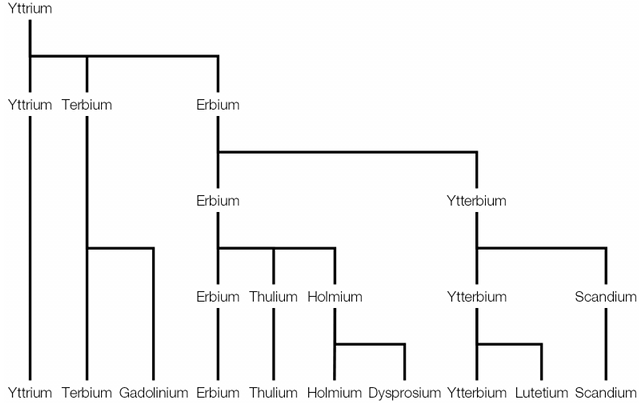
In 1787 one of the students of Lieutenant Carl Axel Arrhenius found a dark-coloured ore that was much too heavy to be coal. Arrhenius took this ore, which he named “ytterbite”, and sent samples to various chemists for analysis. One of these chemists, Johan Gadolin, determined that ytterbite did indeed contain a previously unknown element and called this element yttrium.

In 1843 Carl Gustav Mosander demonstrated that ytterbite was actually made of three metal oxides, not one as Gadolin had thought. The original name was kept for one of these three parts and the other two elements named terbium and erbium, both after the village of Ytterby where they were found.

Terbium was later demonstrated to be a mixture of terbium and a new element which was named gadolinium in honour of Gadolin. Erbium was demonstrated to be a mixture of erbium and and a new element which was named ytterbium, again after the village of Ytterby.

Erbium was then itself demonstrated to a mixture of three elements: erbium; thulium, named after Thule, a term used by early map makers for the far north where Sweden is located; and holmium, named after the Swedish capital Stockholm. Holmium was then later demonstrated to be a mixture of holmium and dysprosium, which takes its name from the Greek word dysprositos meaning “difficult to get”, reflecting the difficulty found in isolating it.

Ytterbium was demonstrated to be composed of ytterbium and a new element which was named scandium after Scandanavia, and finally ytterbium was split again to yield ytterbium and lutetium.

A diagram showing the order in which the ten elements were isolated.

Why is Quincy, Washington so popular with tech companies?

Quincy, WA is a small town (population 6750) in the north-west of the US. So why have technology giants Microsoft, Yahoo!, Dell, Vantage Data Centers, Sabey and Intuit all chosen to build huge data centres there? Quincy is now home to nearly 190 000 square metres (more than two million square feet) of data centre.

The answer is very simple: electrical power.

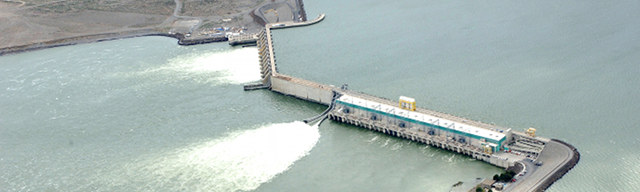
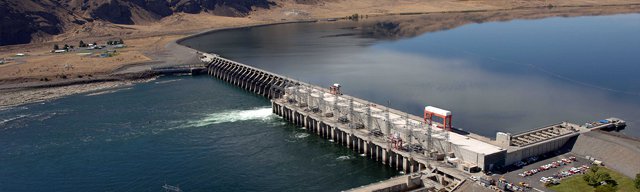
The town of Quincy is close to the Columbia river, the fourth largest (by volume) river in the US. There are fourteen hydroelectric dams on the Columbia river, two of which, the Priest Rapids Dam and Wanapum Dam, provide electricity to Quincy.

The Priest Rapids Dam

The Wanapum Dam

Hydroelectric power is cheap,* but more importantly from the point of view of data centre operators, it is very reliable. The reliability of the electricity supply to Quincy is better than 99.99% which is very important for “mission-critical” always-on services like cloud computing. Using renewable non-polluting hydroelectric power also helps service providers demonstrate their green credentials. Server farms consume a huge amount of electricity – more for cooling than for processing – and using hydroelectric power helps to reduce their associated carbon footprints.

* The local utility company, Grant County Public Utility District, offered electricity at a discount rate to attract users to the area.

Why putting missiles on roofs in London isn’t as dumb as it sounds.

The UK government has recently announced that it will be placing Starstreak HVM surface-to-air missiles on some roofs in London as a security measure during the 2012 Olympics. This has caused a bit of a kerfuffle.

Below are some thoughts on the issue from a physicist’s point of view.

What are Starstreak missiles and how do they work?

The Starstreak is a short-range laser-guided surface-to-air missile. When launched it very quickly accelerates to Mach 3.5 (1200 metres per second) and is then guided onto its target by a pair of laser beams projected from its ground-based aiming unit. Being laser-guided means that unlike heat-seaking or radar-seeking missiles the Starstreak cannot be avoided through the use of chaff or flares; however unlike those missiles it does not have fire-and-forget capabilities.

The Starstreak Light Multiple Launcher showing three Starstreak missiles and the guidance unit.

Once the Starstreak approaches its target it releases three 900 gram tungsten-coated beam-riding submunitions. Once one of the submunitions (or all three) impacts the target a short delay fuse is activated and the 450g of explosive inside the submunition explodes inside the target, throwing out tungsten alloy shrapnel and tearing it to pieces.

What scenario is the deployment of Starstreak missiles designed to prevent?

My guess is that the government is trying to defend against suicide bombers using aircraft as weapons. A heavy aircraft moving at high speed has a large amount of kinetic energy and this, coupled with the chemical potential energy in the fuel, makes it a formidable weapon.* The Olympics will concentrate a large number of people in a small space which makes the Olympic sites attractive targets.

If a plane is shot down, won’t it kill people when the wreckage lands?

It depends on the size of the aircraft involved. A light aircraft at high altitude wouldn’t produce much dangerous wreckage, a low-flying jumbo jet would. But falling wreckage will kill far fewer people than an aeroplane striking one of the Olympic sites would.

The force of the missile’s explosion will tear any aircraft into pieces, and once the structural integrity of the aircraft is ruined the force of the wind will tear it into further smaller pieces. Each of those falling pieces will reach terminal velocity relatively quickly and will therefore strike the ground at a lower speed than if it were flown into the ground under power. The video that has been going around showing a helicopter shot down by a Starstreak missile crash into the ground in a fireball is of a guidance test – the missile in the video was not carrying an explosive payload.

What about burning jet fuel hitting the ground?

This is much less of a problem. An explosion inside an aircraft, combined with the high-speeds involved would aerosolise the fuel, causing it to burn up very quickly in mid air. Again, this is a much lower risk than if a plane full of jet fuel were to crash into one of the Olympic stadia.

Won’t the missile launches damage the buildings they’re launched from?

No. The Starstreak missile is ejected from its launch tube by a low power first stage rocket motor that is extinguished before the missile leaves the tube. The powerful second stage motor doesn’t kick in until the missile is safely away from the launcher, meaning that there is almost no recoil at all. The launch of a Starstreak missile produces no significant overpressure so there is no danger to windows or walls. The missiles have to be launched from roofs or open spaces because the rocket requires a certain amount of space to accelerate to attack velocity.

* It was the chemical energy in the tens of thousands of litres of fuel that were responsible for the collapse of the Twin Towers in the 9/11 attacks. Had the planes had no fuel aboard the Towers would have survived.

The classified Space Shuttle missions

The Space Shuttle flew a total of 135 missions in its lifetime. Of these 135 missions, seven were classified Department of Defense missions whose purposes were never officially announced.*

  • STS-51-C (15th mission, January 1985) deployed a Magnum satellite designed to intercept communications, mainly from the Soviet Union and China.
  • STS-51-J (21st mission, October 1985) deployed two satellites that form part of the Defense Satellite Communications System that allows the military to communicate with units all across the globe.
  • STS-27 (27th mission, December 1988) deployed the first Lacrosse radar imaging reconnaissance satellite. It is alleged (on Wikipedia) that one of the uses of the Lacrosse system would have been to provide real-time targetting data to the B-2 Spirit stealth bomber.
  • STS-28 (30th mission, August 1989) deployed one of the satellites that forms part of the second generation of the Satellite Data System (SDS2) which relays data from low-orbit reconnaissance satellites.
  • STS-33 (32nd mission, November 1989) deployed another Magnum satellite.
  • STS-36 (34th mission, February 1990) deployed a MISTY photographic reconnaissance satellite and the PROWLER satellite. MISTY satellites are alleged to have both optical and radar stealth capabilities to make them difficult to track. The purpose of PROWLER is uncertain, but it is probably designed to inspect other satellites and intercept signals; it has been tracked from Earth approaching close to Russian communication satellites.
  • STS-38 (37th mission, November 1990) deployed the second of the SDS2 satellites.

There was also one partially classified mission:

  • STS-53 (52nd mission, December 1992) deployed the third SDS2 satellite along with a number of unclassified experiments.

The National Reconnaissance Office, one of the seventeen “elements” of the US Intelligence Community, actually influenced the design of the Space Shuttle, having its payload bay size increased so that it could accommodate the KH-9 HEXAGON spy satellite. In the end all of the KH-9 satellites were actually launched by third generation Titan rockets.

* Everything in this post should be heavily prefaced with “allegedly”.