Category Archives: General

A-series paper

There are not many things in this world that I hate more than Letter Size paper.

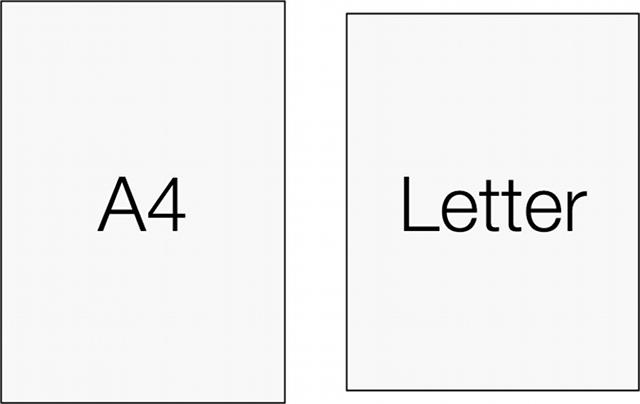
Just look at it. Isn’t it horrible? Sitting there being based on outdated imperial units, looking all wonky and fat.

But instead of explaining in great detail why I hate Letter Size paper I’m going to explain why I love its main competitor: A4 size paper.

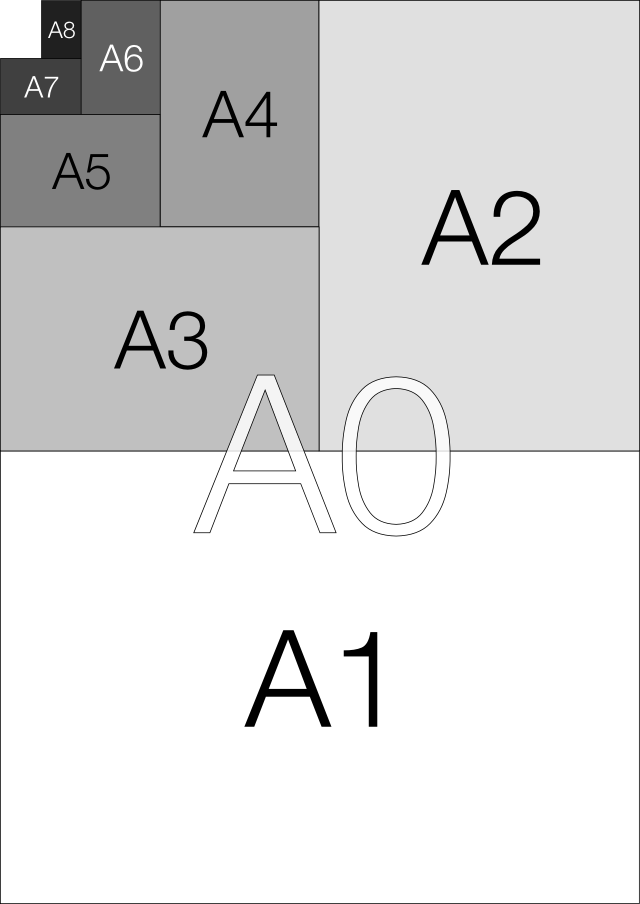
A4 is the fourth size in the metric International Standard (ISO 216) A-series of paper which runs from A0 (the largest) to A10 (the smallest). The A-series is constructed so that the longer side is 1.414 (√2) times the length of the shorter side, which makes each size in the series composed of two copies of the next-smallest size.

If x is the length of the shortest side then the area of an A-series sheet of paper is 1.414x2. Given that the first size in the series, A0, has an area of 1m2, that means that the short side of Ao is 841 millimetres and the long side 1189 mm. From this, the dimensions of all the remaining sizes in the series can be found.

On the chance of dying in a game of Russian roulette

In a standard game of Russian roulette one bullet is inserted into an otherwise empty “six-shooter” revolver and the cylinder is then spun. Each player then takes turns putting the gun to their head and pulling the trigger until one of them dies.

So if you are forced to play a game of Russian roulette, is there any advantage to going first? Or to going last? Or is it best to play somewhere in the middle?

You might think that as the game progresses your chance of dying increases. In the first round there is a 1 in 6 chance of the bullet being lined up with the barrel; in the second round the chance rises to 1 in 5, all the way through to the final sixth round where the chance is 1 in 1, or certain.

But this is not correct, as you haven’t taken into account the chance that you won’t have to play because someone has already shot themselves in the face. If you multiply the chance of a bullet being in the chamber with the chance of having to play you can calculate the risk of dying in each round.

  • 1st round: 1/6 chance of dying × 6/6 chance of having to play = 1 in 6
  • 2nd round: 1/5 chance of dying × 5/6 chance of having to play = 1 in 6
  • 3rd round: 1/4 chance of dying × 4/6 chance of having to play = 1 in 6
  • 4th round: 1/3 chance of dying × 3/6 chance of having to play = 1 in 6
  • 5th round: 1/2 chance of dying × 2/6 chance of having to play = 1 in 6
  • 6th round: 1/1 chance of dying × 1/6 chance of having to play = 1 in 6

So the answer is no, the turn you take in a game of Russian roulette does not make a difference. Suffice it to say that playing a game of Russian roulette in any way is a Really Bad Idea.

Vitamin D is not a vitamin

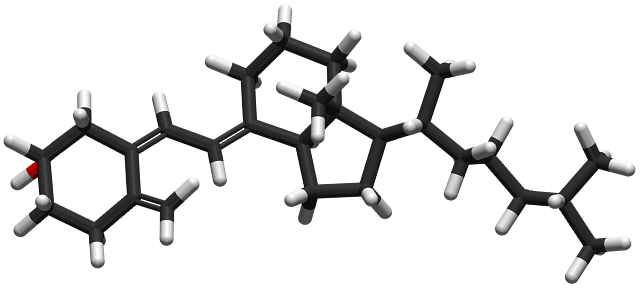
Vitamin D is not a single chemical but rather a group of related compounds: ergocalciferol (vitamin D2), a 1:1 mixture of ergocalciferol and lumisterol (vitamin D1), cholecalciferol (vitamin D3), 22-dihydroergocalciferol (vitamin D4) and sitocalciferol (vitamin D5).

When these compounds reach the liver they are converted to the prohormone calcidiol and then to calcitriol by both the kidneys and by macrophages in the immune system. Calcitriol is a hormone that regulates the concentration of calcium and phosphates in the blood and this is why vitamin D is essential for the growth and remodelling of bone and why a vitamin D deficiency leads to rickets.

A molecule of cholecalciferol.

A vitamin is a substance which the body requires but which it cannot produce by itself. Vitamin D does not fall into this category because the body can produce its own Vitamin D when exposed to sunlight: the major forms of vitamin D, the D2 and D3 forms, are produced in the skin when precursor chemicals (provitamins) react with ultraviolet light.

Vitamin D3 is formed when 7-dehydrocholesterol, itself formed by the oxidation of cholesterol from dietary fats*, reacts with medium wave ultraviolet (UVB) light with wavelengths between 270 and 300 nanometres. Vitamin D2 is formed in a similar reaction when dietary ergosterol reacts with UVB light to form viosterol and then D2. Fungi are particularly high in ergosterol, making them an important source of provitamin D for vegans.

* This is debated, see for example Hartmut Glossmann, “Origin of 7-Dehydrocholesterol (Provitamin D) in the Skin”, Journal of Investigative Dermatology 130 (2010): 2139–2141. doi:10.1038/jid.2010.118.

The plane that shot itself down

The Grumman F-11 Tiger was the US Navy’s first supersonic fighter jet. It came equipped with four Colt Mark-12 cannons that fired 20mm projectiles at more than 1000 metres per second.
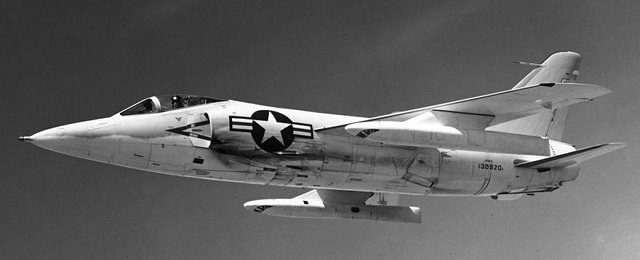
Grumman F-11 Tiger, serial number 138620

In September 1956 Thomas W. Attridge, a Grumman test pilot, was flying Tiger #620 in a test flight over the Atlantic Ocean; part of this test flight was to test-fire the Tiger’s cannons. At 20 000 feet Attridge entered a shallow 20° dive and at an altitude of 13 000 feet fired a 70-round burst from one of the cannons. He then activated the Tiger’s afterburners and entered a steeper dive, firing a 55-round burst from the cannon at 7000 feet to empty the cannon’s gun belt.

At this point three of the rounds that he had fired at the higher altitude, which had been slowed by air resistance and which had curved towards the Earth under the effect of gravity, struck the aeroplane’s windshield, nose cone and one of the engine intakes. With reduced engine power available Attridge was unable to return to Grumman’s Long Island airfield and when the engine finally died he was forced to crash land, 800 metres short of the runway.

Despite the unused fuel catching fire, and unfired ammunition from the other cannons “cooking off“, Attridge survived with only a broken leg and three damaged vertebrae; had the cannons been armed with explosive rounds, as would normally be the case, it is unlikely that he would have survived. Attridge later went on to become the project manager for LM-3, the first Apollo Lunar Module to be rated for human spaceflight, which was used as part of the Apollo 9 mission.

In 1973 another Grumman test pilot, Pete Purvis, also shot down his own plane,* this time  with a dummy AIM-7E Sparrow III air-to-air missile that pitched upwards after being released from its hardpoint and struck the wing of the F-14 Tomcat that Purvis was flying. Both Purvis and his Weapons Systems Officer ejected safely.

via Futility Closet

* Source: The Day I Shot Myself Down by Pete Purvis. Purvis also worked on the Fulton Skyhook recovery system.