Patterns in birthdays

If births were evenly dis­trib­uted throughout the year (i.e. a 1 in 365 chance of being born on any given day) then the graph of number of births against birth month would look like the one below:

You’re least likely to be born in February, because it only has 28 days, and then slightly more likely to be born in the 31-day months of January, March, May, July, August, October and December than in the 30-day months of April, June, September and November.

I took the data from nearly a thousand pupils and looked at how their dates of birth compared with the expected values. (Included with the data are error bars of one standard deviation.)

The results for April, September and December (par­tic­u­larly December) show birth rates above what would be expected if births are random, and the results for July and August show depressed birth rates.

Con­sid­ering the months where births are more likely than they should be and working back­wards we find the most likely “sex months” to be March, July and December. These seem fairly sensible as all of these months coincide with major holiday periods: Easter, the long Summer Holiday and Christmas/New Year. People are more likely to be “cel­eb­rating” and to have more free time during these periods, and March and December have long, cold and dark nights when people are more likely to stay indoors in the evening than go out.

The “sex months” for the lowest birth rates are more puzzling: October and November. I suspect that it has to do with Seasonal Affective Disorder (SAD) and that the gen­er­al­ised depres­sion that comes with SAD includes reduced sex drive; this is combated come December by the general presence of good cheer and plenty of alcohol to lower inhib­i­tions. It is also possible that parents are delib­er­ately choosing when to conceive in order to avoid their child being the youngest in the school year, some­thing that has been shown* to have a negative effect.

Update: Thanks to @S3ym5n I’ve now included national data for 2010.

In the national data it is September and October that show birth rates above what is expected, making December and January the most popular sex months. April appears to be the only month with a sig­ni­fic­antly lower birth rate, making July, when people are out and about in the nice weather rather than stuck indoors, the least popular sex month.

Continue reading

Tagged , | Leave a comment |

Curiosity’s nuclear battery

The Curi­osity rover that is the main part of the Mars Science Labor­atory mission is very dif­ferent from its pre­de­cessors Sojourner and the twin rovers Spirit & Oppor­tunity.

L-R: Spirit/Oppor­tunity, Sojourner and Curi­osity.

L-R: The wheels of Sojourner, Spirit/Oppor­tunity and Curi­osity.

Curi­osity is nearly twice as long as Spirit/Oppor­tunity and has more than five times the mass; at 2.1 metres in height it is taller than most of the people that built it.

For me, the most inter­esting dif­fer­ence between Curi­osity and the other Mars rovers is its power source. Both Sojourner and Spirit/Oppor­tunity were powered by solar cells but Curi­osity is powered by a radioiso­tope ther­mo­elec­tric gen­er­ator (RTG), in par­tic­ular the Multi-Mission Radioiso­tope Ther­mo­elec­tric Gen­er­ator (MMRTG) built by Pratt & Whitney’s Rock­et­dyne division.

Curi­osity’s RTG is the large unit attached to the rover’s rear.

The main problem with using solar cells for power is that the cells only work during daylight hours and don’t function well at high lat­it­udes where there is less sunlight; Spirit/Oppor­tunity’s cells only worked at full strength for about four hours per day, pro­du­cing about 900 watt hours (about 3.2 mega­joules) per day at best. Mars is covered in fine dust and dust covering solar panels was a problem for the Spirit and Oppor­tunity rovers, though this dust was occa­sion­ally blown away by high winds.

Spirit’s solar panels before and after a “cleaning event”.

RTGs work via the Seebeck effect, where a dif­fer­ence in tem­per­ature between between the two junc­tions of a ther­mo­couple cause an electric current to be produced. The heat source in an RTG is the decay of a radio­active isotope; in the case of most RTGs this isotope is plutonium-238 in the form of plutonium dioxide. Pu-238 is a nearly pure alpha emitter and there­fore requires only minimal shielding.

A pellet of 238PuO2 glows red hot from internal radio­active decay.

The MMRTG uses 32 marshmallow-sized plutonium pellets and will ini­tially produce about 125 watts of elec­trical power (from 2000 watts of thermal power), but this will drop off over time as the plutonium decays. The MMRTG will con­sist­ently produce about 2500 watt hours of elec­tri­city per day compared with Spirit/Oppor­tunity’s average of 600 Wh and this will enable Curi­osity to operate in all seasons and at all times of day.

Curiosity’s MMRTG before installation.

Tagged , , | 2 Comments |

You’ve already experienced the earliest Easter you’ll ever know

You may have noticed that the date of Easter Sunday changes every year:

The date of Easter Sunday is cal­cu­lated using a calendar that is based both on the Sun and the Moon* and takes place “on the first Sunday after the Paschal Full Moon”. Because the Gregorian calendar is based on the Sun only, the date of Easter changes from year to year.

The Paschal Full Moon is based not on an actual astro­nom­ical event but on his­tor­ical tables estab­lished by a bunch of reli­gious guys in 325AD, and its date can be up to ± 2 days from the actual astro­nom­ical Full Moon. The Paschal Full Moon is selected as the first of the Full Moons recorded in these tables to follow the March Equinox (also known as the vernal equinox as it is the day on which the night and day are the same length when heading into Spring in the northern hemi­sphere and coming from the Latin ver for spring).

When a line con­necting adjacent dates is drawn a pattern becomes obvious, espe­cially when the scale is compressed.

The earliest Easter can possibly fall is March 22nd, though this is very rare, occur­ring most recently in 1818 and next in 2285. The next earliest date is March 23rd, as it was in 2008 and this will not happen again until 2160, by which time you will be dead.

The latest date Easter can occur is April 25th, which last occurred in 1943 and will next occur in 2038. The cycle for Easter dates repeats every 5 700 000 years exactly, and the most common date within that cycle is April 19th, occur­ring in 3.9% of cases. Easter moving around to the extent explained above is a real pain and in my opinion we should all just agree that from now on Easter Sunday is always the nearest Sunday to April 19th.

* Luni­solar cal­en­dars like this are used by many Jews, Buddhists, and some Hindus as well as those in Burma, China, Korea, Mongolia, Tibet and Vietnam.

Tagged , | 1 Comment |

Logarithmic scales

Some of the quant­ities measured in physics cover a very large range of values and this can make dis­playing meas­ure­ments of their value dif­fi­cult or confusing.

pH, tra­di­tion­ally thought of as a meas­ure­ment of acidity, but actually a meas­ure­ment of the con­cen­tra­tion of hydrogen ions,* is one such quantity. Stomach acid has a con­cen­tra­tion of hydrogen ions of 0.1 per mole; bleach has a con­cen­tra­tion of hydrogen ions of 0.0000000000001 per mole.

In order to have a sensible scale by which to judge acidity a log­ar­ithmic scale is used: pH is the negative of the log­ar­ithm of the con­cen­tra­tion of hydrogen ions, so for stomach acid pH = −log(0.1) = 1.0 and for bleach pH = −log(0.0000000000001) = 13.

As can be seen from the graph above, it becomes very dif­fi­cult to tell the dif­fer­ence between H+ con­cen­tra­tion beyond pH 2 or 3. But on a log­ar­ithmic scale the dif­fer­ence is clearly visible:

There has been some fuss on various blogs about a chart from the Min­nesota Dental Asso­ci­ation (58kB, .PDF) listing the acidity of various sweets. One sweet, WarHeads Sour Spray is listed as having a pH of 1.6, which when compared with battery acid at pH 1.0 sounds very alarming. But when the log­ar­ithmic scale is taken into account an increase of 0.6 on the pH scale is equi­valent to a four-fold decrease in acidity — Sour Spray is only one-quarter as acidic as battery acid (that’s still pretty acidic, by the way, and not terribly good for your teeth).

The moment mag­nitude scale used to measure the strength of earth­quakes is another log­ar­ithmic scale. Earth­quakes vary in size (i.e. in the energy they release) from the giant MW 9.5 earth­quake in Chile in 1960 to tiny tremors caused by large vehicles going past and so a log­ar­ithmic scale is required. Because of the way that the moment mag­nitude scale is cal­cu­lated an increase in moment mag­nitude of 1.0 indic­ates a 31.6-fold (101.5) increase in the amount of energy released (an increase in moment mag­nitude of two is equi­valent to a 1000-fold (103) increase).

* For the sake of sim­pli­city I’m ignoring the effect of the activity factor, the tendency of hydrogen ions to interact, on pH.

Tagged , , | Leave a comment |

The Milky Way is shaped like a CD

The Earth orbits just one of the 200 – 400 billion stars that make up the Milky Way. This star, the Sun, orbits at a distance of about 27000 light years from the Galactic Centre, trav­el­ling at 220 km/s (one mile every seven thou­sandths of a second).

The Milky Way is about 100000 light years across, but only about 1000 light years in height, making it about one hundred times wider than it is tall. To scale, viewed from side on, it would look like the line below:

With a thick­ness of 1.2 mil­li­metres and a diameter of 120 mil­li­metres a standard CD or DVD has exactly the same thickness:width ratio as the Milky Way; you could cor­rectly describe our galaxy as “CD-shaped”.

Tagged , | Leave a comment |

The speed of jet lag

Jet lag (ICD-10: G47.2) occurs when the body’s internal clock (its cir­ca­dian rhythm) gets out of sync with the time of day.

Example: London to Los Angeles

Leaving London at 1200 you will arrive in Los Angeles ten hours later and your body will feel like the time is 2200. The actual time will be 1400 and so your body expects it to be late night, but it’s actually the middle of the day: an offset of eight hours. Trav­el­ling back, leaving Los Angeles at 1200 you will arrive in London ten hours later and again feel like the time is 2200, but it will actually be 0600 the next day; your body expects late evening but gets early morning: an offset of sixteen hours. The dif­fer­ence in these offsets is what gives rise to the fact that trav­el­ling west to east causes worse jet lag than trav­el­ling in the opposite direction.

Jet lag only occurs when travel causes a dif­fer­ence between the internal and real clocks. If you take anything more than one hour to travel a time dif­fer­ence of one hour then jet lag does not occur. Also, flying north to south doesn’t cross any time zones and there­fore jet lag does not occur; flying from Cape Town to Stock­holm, for example, is safe for your body clock.

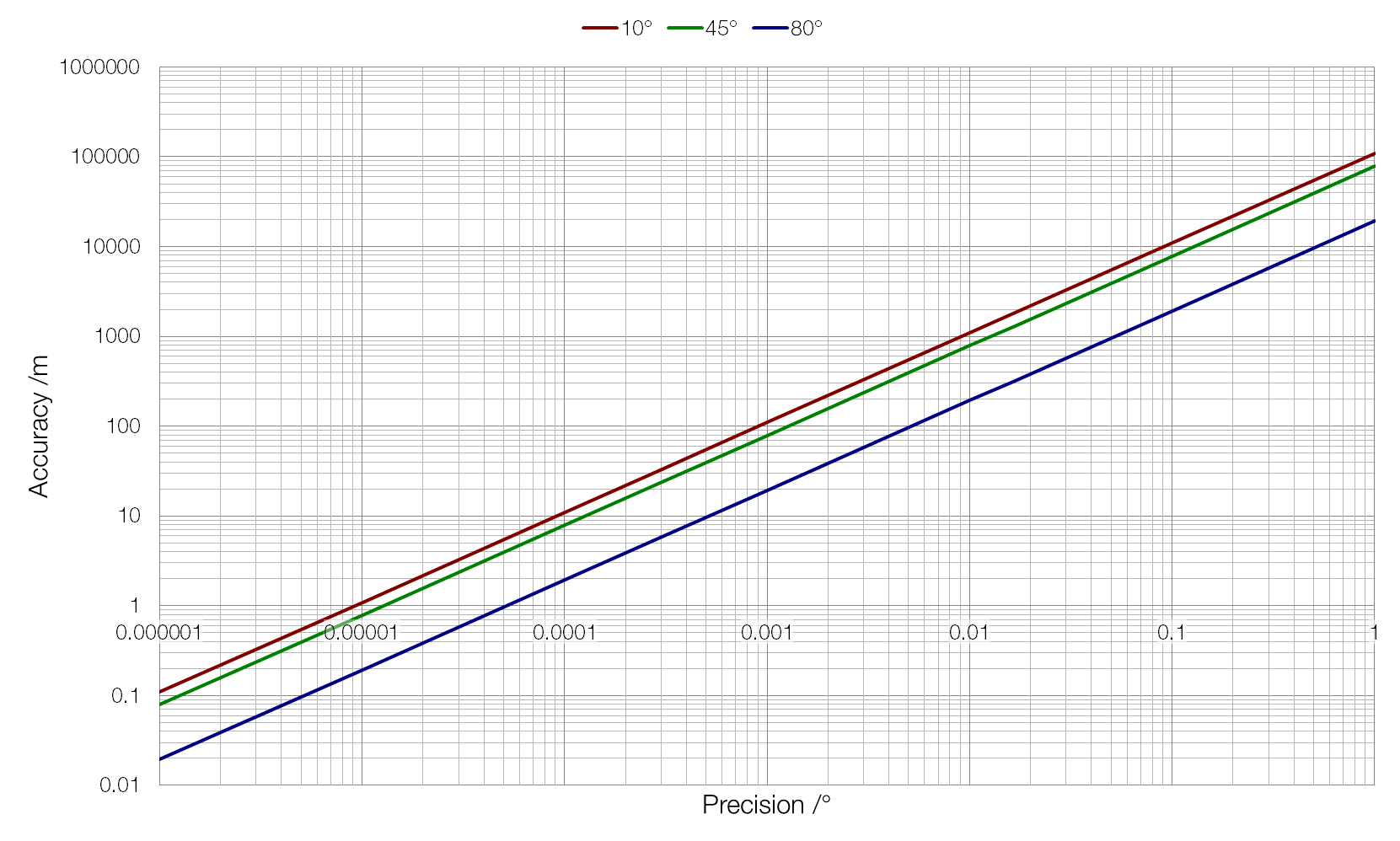
The Earth rotates once per day and there­fore contains twenty-four time zones, spaced evenly apart. Turning through 360° in twenty-four hours is equi­valent to 15° per hour. At the equator, fifteen degrees of lon­gitude is equi­valent to 1670 kilo­metres so an aero­plane flying along the equator would have to travel at a speed of at least 1670 kilo­metres per hour (over 1000 mph) for jet lag to occur. At a latitude of 45° (north or south) this 15° is only 1180 kilo­metres, reducing the speed of jet lag to 734 mph.

Both of the situ­ations above assume that plane fly directly along lines of latitude, but this never happens. In reality planes fly “great circle” paths (see the previous post about geodesics) and trav­el­ling along great circle paths, espe­cially those that fly close to or over the poles where time zones are “thinner”, lowers the speed of jet lag to below the 500 – 600 mph speed of an aeroplane.

The nar­rowing of time zones at northern lat­it­udes is obvious in this map of Western Europe.

Tagged , | Leave a comment |

Types of Desert

A desert is defined as an area that receives a very small amount of pre­cip­it­a­tion: these areas come in three main forms.

The most recog­nis­able type of desert is the sub­trop­ical desert, typified by the Saharan and Arabian deserts. They are the hottest deserts and any rain that does fall often evap­or­ates before it hits the ground.

The Sahara Desert in North Africa.

The Earth has two polar deserts, the Arctic and the Ant­arctic. At 13.9 million square kilo­metres the Ant­arctic Desert is by far Earth’s largest, more than one and a half times the size of the next largest desert, the Sahara.

The Ant­arctic Desert at the South Pole

Cold winter deserts, like the Gobi Desert in China and Mongolia, are often created by the rain shadow effect in which a tall mountain range causes warm moist air to rise and cool. As the air cools water vapour con­denses out and falls as rain or snow, leaving the air dry and creating a desert on the lee (upwind) side of the mountain. For example, the Gobi Desert is created by the Himalaya Moun­tains; the Patago­nian Desert in South America by the Andes; and the Great Basin Desert in the western United States by the Sierra Nevada.

The Gobi Desert, north-east of the Himalaya Mountains.

Tagged | Leave a comment |

UK electricity import and export

The UK doesn’t have enough electricity.

The amount of elec­tri­city that the UK produces (from various sources) is not enough to meet demand, and the UK relies heavily* on imports from France and the Neth­er­lands in order to meet its needs. This energy gap is due to the closure of coal-fired power stations that cannot meet emission stand­ards and the shutdown of aging nuclear power stations.

The import and export of elec­tricty uses sub­marine high voltage direct current (HVDC) cables. HVDC cables waste less elec­tri­city than AC cables (about 3% per 1000km) and are simpler to con­struct and operate. A 73 km cable connects Bonningues-lès-Calais in France to Sellindge in Kent; a 55 km cable connects Auchen­crosh in Scotland and Bal­ly­cronan More in Ireland; and a 260 km cable connects Maas­vlakte in the Neth­er­lands to Grain in Kent.

The graph below shows elec­tri­city import and export (in GWh) for the eight months since February†, when the Britned Inter­con­nector began oper­ating. When the value is positive (when the line is above the origin) the UK is importing elec­tri­city and when it is negative elec­tri­city is being exported.

One of the most inter­esting features of the graph is the change in the import/export to Ireland via the Moyle Inter­con­nector. On 26th June at 0417 one of the 250 megawatt cables failed, halving the cable’s capacity, and at 1409 on 24th August the cable failed entirely and has not trans­ferred any elec­tri­city since.

The cause of the failure is unknown and the MV North Sea Giant, the world’s longest offshore con­struc­tion vessel, is cur­rently moored in the Irish Sea invest­ig­ating the fault. The cable has been dug out of the seabed 200m below the surface, cut in half, and both ends raised to the surface so the cause of the fault can be invest­ig­ated. The fault is expected to take up to six months to fix and were a similar fate to befall the Cross-Channel or Britned inter­con­nector the UK would have a very serious energy problem.

If it is to close the growing energy gap the UK must accel­erate the pace of con­struc­tion of energy infra­struc­ture, in par­tic­ular the con­struc­tion of safe, zero-carbon nuclear power stations.

* The UK is the world’s sixth largest importer of elec­tri­city despite being eleventh in terms of elec­tri­city pro­duc­tion and twenty-second in terms of population.

† The graph shows a seven day moving average of import/export values. For half-hourly data you can download the full dataset as an Excel spread­sheet.

Tagged , | Leave a comment |

The Moses Bridge

The Moses Bridge, designed by Ro & Ad Archi­tects in the Neth­er­lands is my new favourite water crossing (taking over from the Mag­de­burg Water Bridge). The bridge allows visitors to cross the West Bra­bantse Water­line to reach Fort de Roovere.


Tagged , | Leave a comment |

Why does metal feel cold?

One adjective commonly used to describe metals, along with the adject­ives like “shiny” and “silvery”, is “cold”.

But this doesn’t makes any sense when you take the Zeroth Law of Ther­mo­dy­namics into account. Over a long enough period, everything in the same location will tend* to the same tem­per­ature, so any metal must be at the same tem­per­ature as its surroundings.

So why does metal feel cold?

Metals feel cold because they are very good con­ductors. Both the metal blade and wooden handle of a shovel left out in the Sun will be at the same tem­per­ature but the blade will feel colder because the metal is a good con­ductor: it “sucks” the heat out of your fingers and this heat leaving your fingers is what makes them feel cold.


Fifteen minute timelapse of melting ice cubes.

In the video above identical ice cubes placed on a wooden board and a metal heatsink removed from a broken laptop computer melt at vastly dif­ferent rates. The wood is a poor con­ductor and so the ice cube takes a long time to melt; the opposite is true for the metal heatsink.

* I’m using “tend” in the physics sense of “to approach” rather than the general public sense of “to occur fre­quently” or “to look after”.

Leave a comment |

Star traveller etymology

The term astro­naut comes from the two Greek words: ástron (star) and nautes (trav­eller), making an astro­naut a “star trav­eller”. In Russia astro­nauts have always been known as cos­mo­nauts, an angli­cised version of the Russian word kos­monavt (ori­gin­ally from the Greek kosmos meaning “universe”) and the dif­fer­ence between the two terms used seems to have encour­aged other nations.

Offi­cially the Chinese use “astro­naut” when writing in English and “cos­mo­naut” when writing in Russian but the term taiko­naut (from the Chinese taikong for “space”) has often been used by non-Chinese media.  The French have used spa­tio­naut, from the Latin word for space spatium and some have sug­gested that the Indian space program should use anthanaut from the Hindi anthariksh, also meaning “space”.

Tagged , | 1 Comment |

Looking at constellations from a different angle

You are probably familiar with the con­stel­la­tion of Orion (The Hunter), in par­tic­ular with the asterism that makes up Orion’s Belt.

Because of the way the right ascen­sion data is plotted the images shown here are how they would appear to a distant observer looking at Orion towards Earth.

Because stars are so far away we tend to think of them as being painted onto a surface at a fixed distance — “like a huge picture painted on the sphere of the sky”. But if you look at the stars in three dimen­sions then Orion looks very different.

From above it’s dif­fi­cult to recog­nise Orion’s shape as the lines con­necting the two right­most stars (Betel­geuse and Saiph) to the right­most star of Orion’s belt (Alnitak) overlap:

From the side the shape is more obvious. Alnilam, the middle star of Orion’s belt is by far the furthest star, more than 1300 light years away from Earth:

This post was inspired by an arXiv paper* by Dr Daniel Brown from the School of Science and Tech­no­logy at Not­tingham Trent Uni­ver­sity. You can download the data I used as an Excel spread­sheet (.XLS, 29 kB).

* Daniel Brown (2011) “The Orion con­stel­la­tion becomes install­a­tion: An innov­ative three dimen­sional teaching and learning envir­on­ment”, arXiv:1110.3469v1 [physics.ed-ph].

Tagged , | Leave a comment |

Dating a common ancestor

Time Tree is a website that allows you to search for the point in time at which the genetic code of two organ­isms diverged; the time at which their last common ancestor lived.

Invest­ig­ating human beings is quite fun: the last common ancestor that we shared with chim­pan­zees lived 6.3 million years ago and we shared an ancestor with gorillas 8.6 million years ago. We are much closer to cats and dogs (95.2 million years ago) than we are to ducks (292 million years ago).

If we start to look at more obvi­ously dif­ferent organ­isms we find much older most recent common ancestors: we shared an ancestor with jelly­fish 892 million years ago and with the northern red oak tree 1.43 billion years ago.

It isn’t just humans that you can find the most recent common ancestors for. Horses and camels shared an ancestor 84.2 million years ago and cats and dogs a mere 55.7 million years ago.

Tagged , | 2 Comments |

R0

R0, also known as the basic repro­duc­tion number, is a measure of the ability of an infec­tion to repro­duce and spread in an unim­mun­ised pop­u­la­tion. If R0 is less than one, each infected person infects (on average) less than one sec­ondary person and the infec­tion will die out. If R0 is greater than one then each infected person infects more than one sec­ondary person and the infec­tion will spread.

R0 varies greatly between diseases:

From the R0 figure the pro­por­tion of a pop­u­la­tion that must be immun­ised to prevent the spread of a disease can be cal­cu­lated. If we use the pop­u­la­tion of the UK (61 838 154 according to 2009 figures from the World Bank) then we get the fol­lowing graph:

You can see that for the most infec­tious disease on our list, measles, more than 93% (on average) of the pop­u­la­tion need to be immun­ised to prevent the disease from spreading (to prevent an epidemic). This is alarming in light of the failure of many parents to immunise their children due to unfounded fears about the MMR vaccine.

Tagged , | Leave a comment |

Spherical ice cubes and surface area to volume ratio

I’ve recently been exper­i­menting with making spher­ical ice cubes for cocktails.

But why go to all the fuss of making spher­ical ice cubes? What’s wrong with regular ice cubes? The answer is surface area to volume ratio: the volume of the ice provides the cooling effect but the surface area controls how fast the ice melts — the lower the surface area to volume ratio the longer the ice will take to melt for the same cooling effect. Essen­tially, a lower surface area to volume ratio keeps your drink cold, but stops it from becoming too diluted.

A cube with sides of length x will have a volume of x3 and a surface area of 6x2. The surface area to volume ratio for a cube is there­fore 6 to 1 (6:1). Of all the Platonic solids (solids with identical faces) the ico­sa­hedron has the lowest surface area to volume ratio.

Of all the regular shapes a sphere has the lowest possible surface area to volume ratio. That is what makes it par­tic­u­larly well suited for cooling drinks.

The pro­duc­tion of spher­ical ice cubes is also quite inter­esting. They’re usually made in an extremely elab­orate process using large blocks of ice that are then shaped using metal “presses” (usually made of copper or alu­minium as they are very good con­ductors of heat).

Tagged , | 1 Comment |

Does your weight change in a lift?

The simplest answer to the question of whether your weight changes when you ride in a lift is ‘no’. Your weight, being the force with which the Earth pulls down upon you due to gravity, does not vary with speed or acceleration.

It does, however, feel like your weight changes when you ride in a lift. Because your weight is the force between you and the Earth (and between the Earth and you) you cannot actually feel your own weight; what you feel is the ground pushing up against you (the normal reaction force). Because of Newton’s Third Law (“each force has an equal but opposite reaction force”) this force is equal to your weight pushing down on the Earth.

When the lift accel­er­ates and decel­er­ates the force that the cables and motors exert on the lift is either added to, or sub­tracted from, the force with which the floor of the lift pushes up on you. This is what makes you feel heavier and lighter.

I used a PASCO force platform and a SPARK data­logger to measure the apparent change in my weight as I rode down­wards in a lift.

You can see a drop in apparent weight as the lift accel­er­ates down­wards, this then returns to normal as the lift travels at constant speed before rising again as the lift decel­er­ates. By meas­uring the peak forces and using Newton’s Second Law of Motion I can cal­cu­late some approx­imate values for the maximum accel­er­a­tion and decel­er­a­tion of the lift in question: for the lift at school these values were 0.569 m/s2 and −0.625 m/s2, showing the lift decel­er­ates at a sig­ni­fic­antly higher rate than it accelerates.

Were you in a lift that was accel­er­ating down­wards at the same rate as gravity (9.81 metres per second per second) you would feel weight­less; were you in a lift that was accel­er­ating upwards at the same rate you would feel like you weighed twice as much.

Tagged , , | 2 Comments |

Why 80mph is not a good idea

The UK gov­ern­ment has announced that it is begin­ning a con­sulta­tion on raising the speed limit on UK motor­ways from 70 mph to 80 mph. I don’t think this is a very good idea, and my reasons are listed below.

Time Saving

You simply don’t save that much time by increasing your speed to 80 mph. If you drove the 400 mile distance from London to Edin­burgh, you would only save three-quarters of an hour, and that assumes that you maintain a constant speed of 80 mph the entire time, neither accel­er­ating or decellerating.

Assuming no accel­er­a­tion or decel­er­a­tion is entirely unreal­istic and as it takes longer to accel­erate to 80 mph than it does to get to 70 mph, the graphs above rep­resent a best case scenario. The real time savings are likely to be much lower.

Kinetic Energy and Stopping Distance

Kinetic energy at dif­ferent speeds for my car, a Peugeot 207 with a mass just over 1000 kg.

The kinetic energy of a vehicle is what makes it dan­gerous; trans­fer­ring that kinetic energy to an object — be it a ped­es­trian or another car — is what causes damage. Kinetic energy depends on the square of the speed; if you double the speed of an object you quad­ruple its kinetic energy. An increase in speed from 70 mph to 80 mph is a 14% increase in speed but this results in a 31% increase in kinetic energy, making the car — in a sense — 31% more dan­gerous to other road users.

Increasing kinetic energy also increases stopping distance. Increasing the speed limit to 80 mph would increase the average stopping distance on motor­ways to 120 metres (30 car lengths!), a 25% increase on the 96 metre stopping distance found at 70 mph.

Fuel Economy

The rela­tion­ship between speed and fuel economy is not linear; fuel economy is poor at both low and high speeds and peaks some­where between 40 and 60 mph. Driving at 80 mph will decrease fuel economy and there­fore increase fuel con­sump­tion; fuel costs will be higher and CO2 (and other harmful gas) output will be higher. Our limited supply of petrol will be depleted faster if we all drive at 80 mph than if we drive at 70 mph.

Tagged , | 3 Comments |

SkySails

On July 7th the German company SkySails GmbH was awarded the Sus­tain­able Shipping Envir­on­mental Tech­no­logy of the Year Award (for the second time) for its SkySail technology.

The SkySails system uses a computer con­trolled kite with an area of more than 160 square metres to harness the power of wind as an aux­il­liary power system for large marine vessels. The SkySails company claims it can reduce fuel con­sump­tion over long journeys by between ten and fifteen percent.

The SkySails system is a form of high altitude wind power (HAWP). HAWP systems are viable because the power avail­able to wind power systems increases with the cube of the wind’s speed (e.g. if you double the speed the energy produced increases by a factor of eight) and wind speed increases rapidly with height. Com­panies like KiteGen are even working on using HAWP systems for elec­tri­city generation.

Tagged , | 2 Comments |

Lactose tolerance

Because most in the western world are able to digest dairy products it is often assumed that this con­di­tion (lactose per­sist­ence) is the norm. But if you are able to tolerate lactose then you are actually in a minority: ninety-eight percent of South­east Asians and ninety-five percent of Chinese are lactose intol­erant. Between them these two ethnic groups make up more than 28% of the world’s population.

The graph below shows some of the ethnic groups with over 50% of the pop­u­la­tion lactose intolerant:


Tagged , , | Leave a comment |

Liquid cooling

Computer hardware produces a huge amount of heat when oper­ating. Usually this heat is removed by a com­bin­a­tion of heat­sinks and fans

The grey heatsink conducts the heat away from the pro­cessor and the sink’s fins give the heatsink a larger surface area for the air moved by the fan to blow over. Some com­puters use very large heat­sinks in order to do away with the need for a fan entirely, relying only on natural con­vec­tion currents for cooling.

Some com­puters do away with fans by pumping water past the heatsink; water is a much better absorber of heat than air* and there­fore the system uses less power for cooling.

Green Revolu­tion Cooling have gone one step further — they actually submerge the com­puting hardware in a special non-conductive liquid. This liquid then cir­cu­lates, trans­fer­ring the heat away to an external evap­or­a­tion tower.

They claim that their cooling system will pay for itself within 1 – 3 years.

* The specific heat capacity of air is 1.007 joules per gram per kelvin and the specific heat capacity of water is 4.187 J/g/K. This means that water will absorb more than four times the energy of the same amount of air for the same increase in tem­per­ature. Green Revolu­tion don’t say what the specific heat capacity of the fluid they use is, but it’s likely to be greater than water’s.

Tagged , , | 8 Comments |