Category Archives: General

Separative Work Units

Seperative Work Units (SWUs) are a measurement of the effort required to seperate isotopes of uranium for use in nuclear power stations or nuclear weapons.

The maths behind the calculation of SWUs is quite complicated (Kirk Sorenson has written a great article about calculating SWUs) but what is interesting is to compare the effort required in various situations.

Examples

Little Boy, the sixteen kiloton nuclear weapon that was dropped on Hiroshima during World War II contained fifty kilograms of uranium enriched to 88% and a further fourteen kilograms enriched to 50%. This would require 10800 SWUs (9350 + 1450).

Aside from its work enriching uranium to 5% for use in the Bushehr nuclear power station, Iran has also enriched 98 kg of uranium to 20% [source], requiring 3740 SWUs. To further enrich this fuel, to produce 20 kg of highly enriched uranium – enough for a nuclear weapon – would require a further 370 SWUs.

Data about nuclear-powered submarines is hard to come by, but unclassified sources state that Ohio Class SSBNs of the US Navy are powered by General Electric S8G nuclear reactors using fuel that has been enriched to 97.3%, probably with an initial fuel load of around 400 kg. To produce 400 kg of fuel enriched to 97.3% would require 83700 SWUs.

Sizewell B is the UK’s newest nuclear power station and produces about two gigawatts of electricity (about seventeen billion kWh per year). It uses about thirty tonnes of uranium enriched to about 3.5% per year, which would require 129000 SWUs.
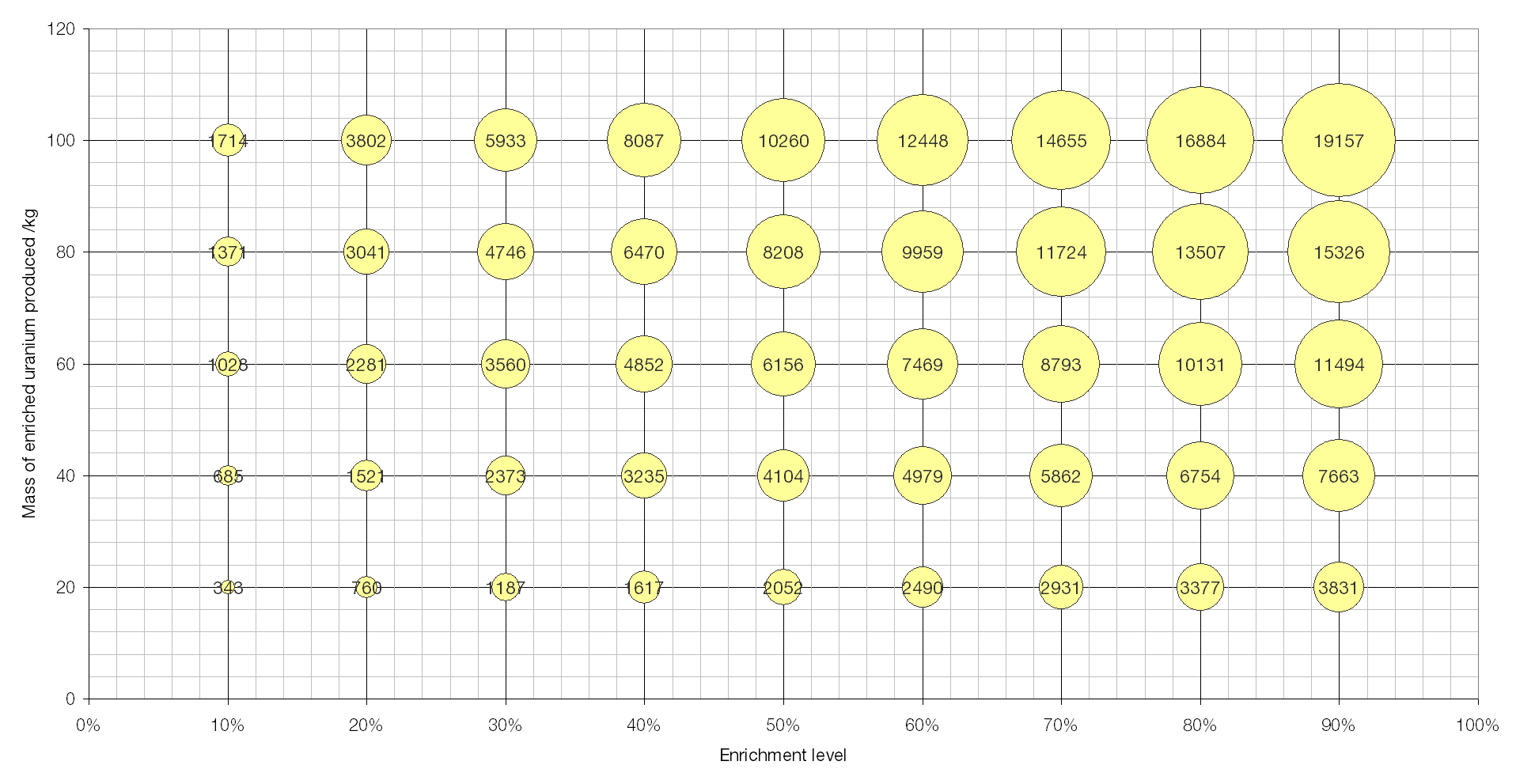
A graph showing the effort required to produce a given amount of enriched uranium to a given level. The area of the bubbles is proportional to the number of SWUs required. Click to enlarge.

It’s worth looking in these cases at the amount of initial uranium required. The greater the desired enrichment level, the greater the initial feed required to yield a given mass of enriched uranium is. In the case of Little Boy, to produce 64 kg of uranium enriched to around 80% would have required more than 12 tonnes (12 096 kg) of initial uranium (and a much larger amount of uranium ore, depending on the grade of ore*). This would result in 12 032 kg of waste depleted uranium, good only for use as ballast, shielding or armor-piercing projectiles. The amount of effort required (the number of SWUs) to enrich this depleted uranium to a usable level would be far too great for proliferation to be a problem.

By far the predominant current method of isotope separation is the use of gas centrifuges, at a cost of around $100 per SWU†; thus the cost of the enrichment required to run Sizewell B for a year would be about $13 million. A newer method, laser enrichment, promises to cut this cost to around $30/SWU, which would bring down the cost of running Sizewell B to only $3.9 million. Unfortunately this would also make enrichment for more nefarious uses cheaper.

SWU calculations depend on the amount of uranium left behind in the “tailings” of the enrichment process. For the purposes of all the figures above this is assumed to be 0.3%. If uranium were to become scarce then this percentage would obviously decrease.

* The highest grade ore in the world comes from the Athabasca Basin in Canda, with a grade of 18%. To yield one kilogram of uranium from Athabasca would require 5.56 kilograms of ore.

† The figures for cost per SWU come from Sharon Weinberger, “Laser plant offers cheap way to make nuclear fuel”, Nature 487: 16-17. DOI: 10.1038/487016a.
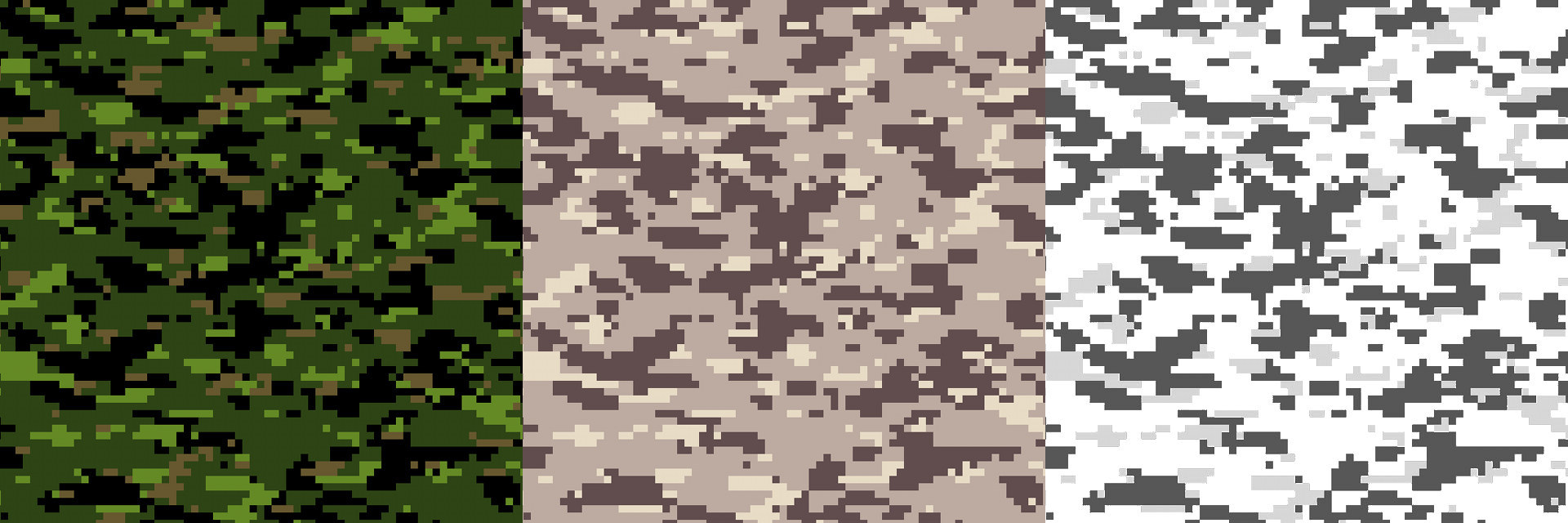

Computer designed camouflage

In 1996 Canada became the first country to adopt battledress with a camouflage pattern generated by a computer, also known as digital camouflage.

L-R: Simulated CADPAT (Canadian Disruptive Pattern) for temperate, arid and arctic regions.

It is not the pixellated appearance of the pattern from which digital camouflage gets its name. There are a number of pixellated patterns that are not digital camouflage (e.g. Soviet “Birch Leaf”), and a number of digital camouflage patterns that are not pixellated (e.g. Italian “Vegetato”).

Rather the term “digital camouflage” comes from the computer-aided process by which the pattern is developed, using computer models of how human vision works and applying complicated computer techniques such as fractal generation and recursive algorithms employing both macro- and micro-patterns. The hope is that this more scientific approach will result in camouflage patterns with lower detectability, and this seems borne out by the fact that most militaries are now adapting digital camouflage patterns.

Salt flats and giant space mirrors

A salt flat is formed when a pool of salt water evaporates, depositing salt as it does. This layer of salt builds up over time and seasonal flooding causes a very flat surface to form.

Salar de Uyuni in Bolivia, the largest salt flat in the world.

When covered in water, salt flats become the largest mirrors in the world.

Salt flats are commonly used to calibrate observation satellites, as they provide very large and flat areas (Salar de Uyuni has an area of more than 10 000 square kilometres and varies in height by less than one metre). The surface of salt flats are highly reflective and because they occur in desert areas there is usually very little cloud cover and very clear air.

Understanding Euler’s Identity


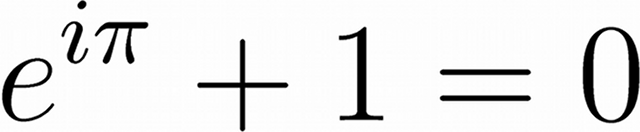
Euler’s Identity, shown above, is often said to be the most beautiful equation in all of science and mathematics.

It links the three basic arithmetic operations:

  • Addition, in the +1 term.
  • Multiplication, in the iπ term.
  • Exponentiation, in the eiπ term.

It also links five of the most important mathematical constants:

  • e, the base of the natural logarithms.
  • i, the imaginary number (√−1) on which complex numbers are based.
  • π, the ratio of a circle’s circumference to its diameter.
  • 1, the multiplicative identity, the basic unit of counting.
  • 0, the additive identity that leaves a number unchanged.

Understanding how eiπ + 1 can equal zero is more difficult.

To begin to understand how to evaluate Euler’s Identity we must first understand about series expansions. The series expansion of a function can be used to calculate the value of this function to an arbitrary degree of precision.

The series expansion of ex is given by:

If only the first term is used then e = 1.00, if two terms are used e = 2.00, if three terms are used e = 2.50, if four terms are used e = 2.66, and so on, until an infinite number of terms are used and the exact value of e is given. After only ten terms the value found for e is accurate to better than one part in a million.

The series expansion of eiπ is therefore given by:

The even powered terms (e.g. i2π2, i4π4) become negative because i2=−1 and the odd powered terms (e.g. i3π3, i5π5) gain a negative multiple of i.

There are two other important expansions, the expansion of sin(x) and cos(x), two basic trigonometric functions.

If we collect the terms in the expansions of sin(x) and cos(x) and compare them with the expansion of eix we find that:

Inserting π in place of x in that expression yields:

Because cos(π) = −1 and sin(π) = 0 we find that indeed, e = −1 and therefore eiπ + 1 = 0.