In maritime terms there is a difference between a collision and an allision.
When two moving objects strike each other, that is a collision.
When a moving object strikes a stationary object, that is an allision.
In maritime terms there is a difference between a collision and an allision.
When two moving objects strike each other, that is a collision.
When a moving object strikes a stationary object, that is an allision.
The Travelling Salesman Problem is a classic problem in mathematics. The objective of the problem is to find the shortest possible route between a number of cities that visits each city only once and returns to the starting point.
Below is a rendering of the text “MrReid.org” created by solving the Travelling Salesman Problem. If you look carefully you can see that in each case the text is composed of one single line, drawn “without lifting the pen from the page”.



Top to bottom: “MrReid.org” rendered using 1000, 2000, and 5000 nodes. Click to enlarge.
By taking a greyscale image, and turning it into a weighted Voronoi diagram (using Adrian Secord’s algorithm) it is possible to create a “map” in which the “cities” are placed closer together in dark areas and further apart in light ones.

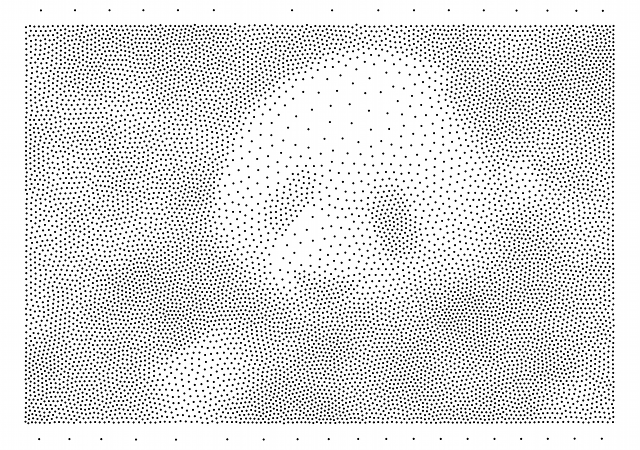
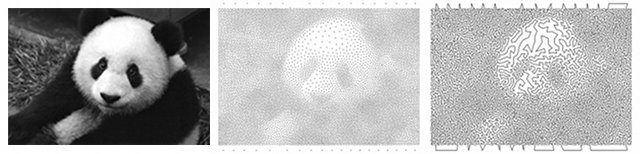
Top: the original panda image. Bottom: weighted Voronoi diagram of panda image (10000 nodes).
By solving the Travelling Salesman Problem for this “map” (using the Nearest Neighbour algorithm for the first pass and and the 2-opt algorithm for subsequent optimisation) the following “route” is produced.
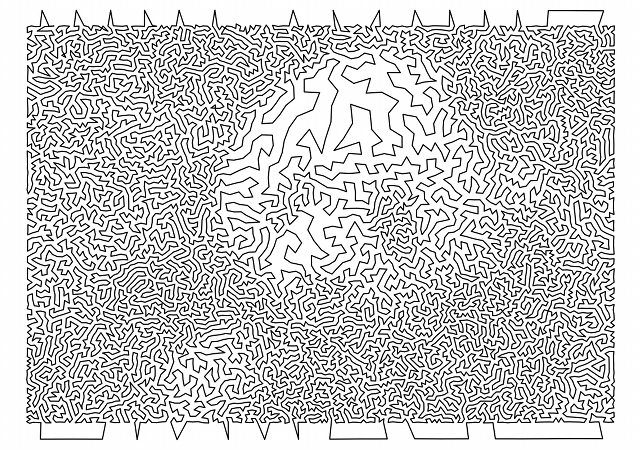
There isn’t really enough contrast between the background and foreground in the original panda image, but it works if you squint a little bit.
Is the Drinking Bird a perpetual motion machine?
Depending on what type of perpetual motion machine is being described, all perpetual motion machines violate either the First or Second Law of Thermodynamics, so the answer is no, the Drinking Bird is not a perpetual motion machine.
So what powers the Drinking Bird? If it is moving it must have kinetic energy and the Principle of the Conservation of Energy says that this kinetic energy must have come from somewhere. It does not come from the water as, despite what you might have read about “water powered cars”*, water is not a fuel and does not store or transfer energy.
The correct answer is that the Drinking Bird is powered by the ambient heat of the room it is placed in. The process that occurs is as follows:
The Drinking Bird is a heat engine that uses the difference in temperature between the head and the base of bird to perform work, transferring thermal energy to kinetic energy. This temperature difference is created by evaporation that is powered by a room’s ambient heat. If you were able to perfectly insulate a room so that no thermal energy could enter or leave then you could cool the room down by leaving a drinking bird running.†
* “Water powered cars” are actually being powered by hydrogen fuel cells. The hydrogen comes from the water and is extracted using electricity, making “water powered cars” actually powered (indirectly) by electricity.
† Friction between the air and the bird, and between the bird and its bearings would transfer some of the bird’s kinetic energy into thermal energy, heating the room back up.
One of the most difficult aspects of the Manhattan Project that built the first nuclear bombs was obtaining enough enriched uranium to make the bomb work. The enrichment of uranium took place at a site near the Oak Ridge National Laboratory and used three different methods: electromagnetic separation, gaseous diffusion and thermal diffusion. The gas centrifuge method of separation that is the modern standard could not be made to work at the time.
The final stage of enrichment was the electromagnetic separation stage that took place in a building known as Y-12; the output from the S-50 thermal diffusion plant and the K-25 gaseous diffusion plant (which at the time was housed in the world’s largest building by floor space) was used as input for Y-12.
Electromagnetic seperation was carried out on calutrons, which used giant electromagnets made of silver* to deflect the paths of ionised uranium-235 by a little more than ionised uranium-238. Initially these calutrons were operated by scientists from the University of California, Berkeley where the calutron was invented by Ernest Lawrence, but when a reasonable rate of return was achieved the operation of the calutrons was turned over to operators from the Tennessee Eastman Company.
These Tennessee Eastman operators were mostly women and all of them were only educated to high school level.
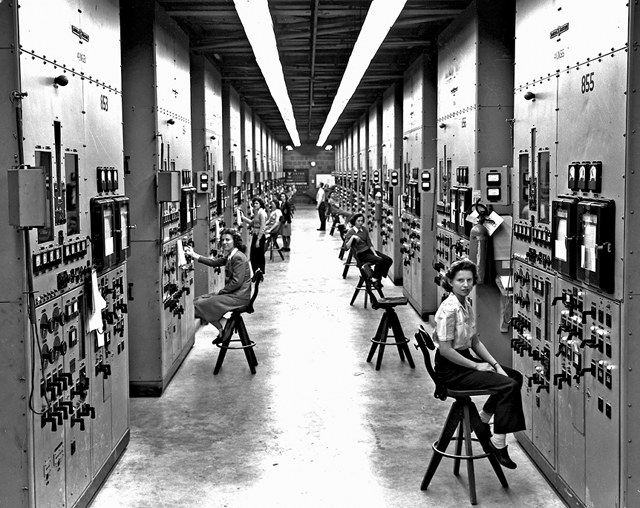
“The Calutron Girls”
Major General Kenneth Nichols, the man in charge of ore procurement and feed materials, pointed out to Ernest Lawrence that Eastman’s “hillbilly girl” operators were achieving better rates of production that his scientists and engineers had and a competition took place, with Eastman’s operators beating out Lawrence’s scientists. Nichols put this down to the fact that the girls were “trained like soldiers not to reason why … [whilst] the scientists could not refrain from time-consuming investigation of the cause of even minor fluctuations of the dials”.
During the operation of the calutrons the staff from Tennessee Eastman had no idea what they were doing: they operated switches and dials and monitored meters, but had no idea what those switches and dials did or were related to.
Gladys Owens, seated in the foreground of the photograph above, only discovered what her job was when taking a public tour of the K-12 facility fifty years later. Owens stated that she was told by a manager during a training session “We can train you how to do what is needed, but cannot tell you what you are doing. I can only tell you that if our enemies beat us to it, God have mercy on us!” and said that “Everywhere you looked it told you to keep your mouth shut!”.

Gladys Owens returns to K-12, fifty-nine years later.
* Normally copper would be used to construct electromagnets but this was in short supply due to the war. Kenneth Nichols met with the Under Secretary of the Treasury and arranged to borrow 13 300 tonnes of silver (worth about £170 million at today’s prices) from the US’s West Point Bullion Depository. After the war ended the silver was melted down and returned, with only a tiny fraction being lost in the process.
Baobab is the common name of the eight species of tree of the genus Adansonia. Baobabs are well-known for their distinctive broad and swollen trunks.
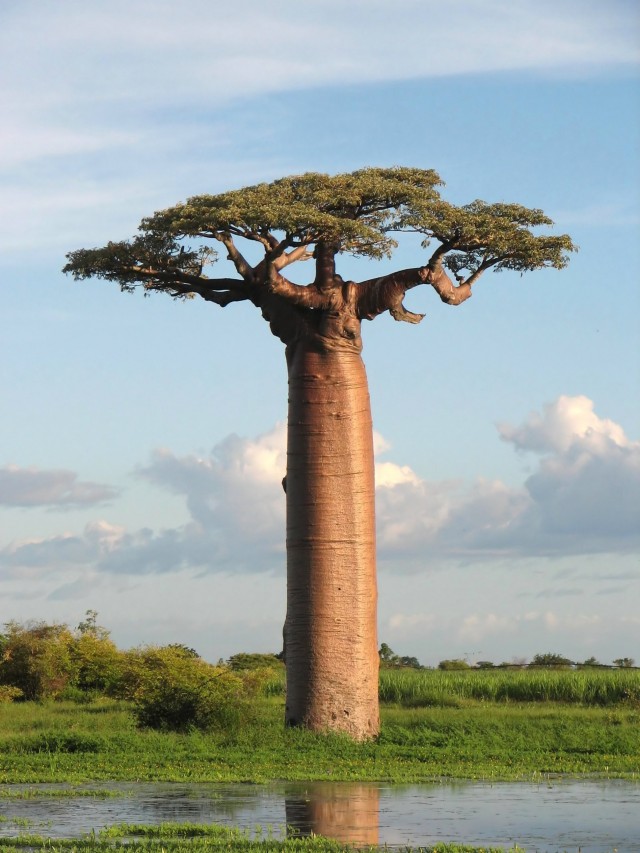
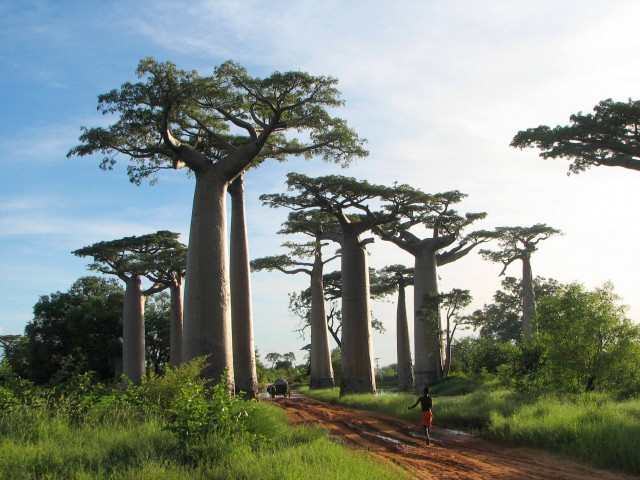
Two photographs of Grandidier’s Baobab, Adansonia grandidieri.
All Baobab’s occur in arid regions, and survive by storing water (sometimes as much as 120000 litres) inside their trunks, making them a useful source of water for human populations. Their bark is used for cloth and rope, their leaves for medicines and condiments, their fruit (“monkey bread”) as food and their seeds to replace coffee. It is not for nothing that the Baobab is sometimes referred to as the Tree of Life.
The unusual trunk structure makes it very difficult to date Baobab trees, as they do not produce annual growth rings, but radiocarbon dating has shown some to be more than 2000 years old.