Category Archives: General

Tog

Duvets are often rated by their “tog” rating. But what is tog?

Tog is a measure of a duvet’s thermal resistance. It measures the extent to which the duvet resists the transfer of thermal energy through it. One tog is equal to one-tenth of a metre squared kelvin per watt or 0.1 m²K/W. Thermal resistance can be a bit difficult to understand, but the reciprocal of thermal resistance, the thermal conductance, is a bit easier to grasp.

A one tog duvet would have a thermal resistance of 0.1 m²K/W and a thermal conductance of 10 W/m²K, a two tog duvet would have a thermal resistance of 0.2 m²K/W and a thermal conductance of 5 W/m²K, and so on.
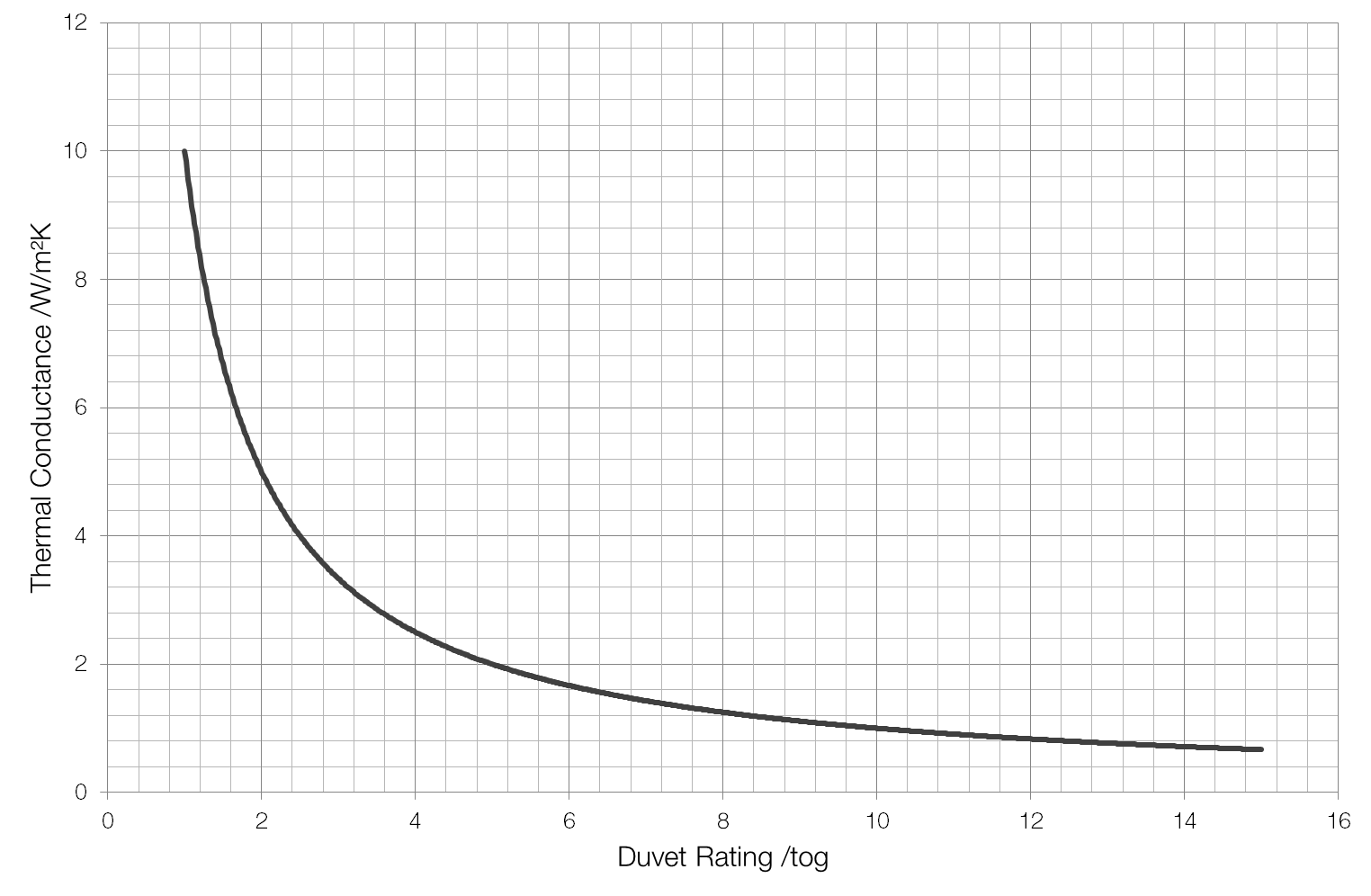
A lightweight summer duvet* has a tog rating of about four, so its thermal conductance is 2.5 W/m²K. This means that 2.5 watts of thermal energy will move through each square metre of the duvet for every one kelvin difference in temperature between the sides of the duvet.

Whilst sleeping the average person puts out about seventy watts of heat. Some of this heat will be radiated into the mattress, and some will leak out around the head and neck and edges of the duvet, but it’s not unreasonable to think that around fifty watts is going into the air surrounding the body underneath the duvet.

To maintain a constant temperature underneath the duvet the amount of heat lost must be equal to the amount of heat output by the body. If an eight tog (1.25 W/m²K) autumn duvet has an area of three square metres then this break-even point will be reached when the difference in temperature between the two sides is about thirteen degrees (50 ÷ (3 × 1.25)). Given a skin temperature of 35°C this duvet will therefore keep you at a constant temperature in a room at a temperature of 22°C. If the room is colder than 22°C then the air underneath the duvet will gradually cool down and the body will increase its rate of heat production to compensate. If the room is hotter than 22°C then the air around the body will continue to increase in temperature (until it reaches the same temperature as the body) making you uncomfortably hot and will probably cause you to throw off the duvet or stick your leg out from underneath the covers to increase the rate of heat loss.

If the duvet in the example above is replaced with a four tog summer duvet with a conductance of 2.5 W/m²K then the room would have to be a scorching 29°C, but it’s unlikely that in this situation you would want a constant temperature – you’d want to remain cool overnight. If it was replaced with a twelve tog winter duvet (conductance = 0.83 W/m²K) then the room could go down to 15°C before a net heat loss occurred.

All the calculations above are based on some unreasonable assumptions, the most obvious one being that heat is not lost throughout the whole three square metre surface of the duvet. If a person is “using” only half this area then the numbers involved change to reflect more realistic values: for a winter duvet the temperature difference required can be greater and for a summer duvet it can be smaller. The calculations also ignore the effect of any heat radiated into the mattress below the person and the insulating effect that this mattress would have.

* John Lewis classifies summer duvets as those rated at between three and four-and-a-half tog, spring/autumn duvets as those between seven and ten-and-a-half tog and winter duvets as those between twelve and thirteen-and-a-half tog.

The Trivers-Willard hypothesis

The Trivers-Willard hypothesis states that when conditions are good, parents have more male offspring; and when conditions are poor, parents have more female offspring. The thinking behind this is that in favourable conditions males will be able to mate with many females before they die and have a greater chance of passing on their genes; and when conditions are poor males will not be able to mate with as many females and are more likely to be out-competed, and therefore a female will have more chance of passing on genetic material than any particular male.

The Trivers-Willard hypothesis seems to hold true for human beings. In a study of the Forbes Billionaires List it was found* that the children of billionaires were 60% male, and if only male billionaires were considered then this percentage rose to 65%. The effect was the same whether the billionaires were self-made or had inherited their fortunes, suggesting that if there was a biological reason for success in business it was not relevant in selecting the sex of offspring.

It is uncertain what causes the Trivers-Willard effect, but a 2001 paper suggested† that “condition” was linked to the availability of food and of glucose in this food, and that the presence of elevated levels of glucose in the mother’s blood favours the survival of male blastocysts. This has led to the idea of the “Trivers-Willard Diet“, designed to enable parents to select the sex of their offspring.

* Elissa Cameron and Fredrik Dalerum, “A Trivers-Willard Effect in Contemporary Humans: Male-Biased Sex Ratios among Billionaires”, PLoS ONE 4(1) (2009): e4195. DOI: 10.1371/journal.pone.0004195.

† Melissa Larson et al, “Sexual dimorphism among bovine embryos in their ability to make the transition to expanded blastocyst and in the expression of the signaling molecule IFN-τ”, Proc Natl Acad Sci 98(17) (2001): 9677-9682. DOI: 10.1073/pnas.171305398.

Nuclear art forgery

Nuclear weapons* are triggered by neutron initiators, devices that produce a sudden burst of neutrons on activation. They are most often constructed from a mixture of beryllium-9 and polonium-210. The polonium emits high-energy alpha particles, and when brought into contact with the beryllium it causes the beryllium to transmute into carbon with the release of a neutron. This neutrons causes an atom of uranium-235 to split (to fission) and in the process release a huge amount of energy and more neutrons that go on to cause further fissions.

This uncontrolled chain reaction results in the production of many exotic isotopes, as the uranium atoms split to form “chunks” of other elements. For example, it was in the aftermath of the ‘Ivy Mike’ test of the first thermonuclear bomb that the elements einsteinium and fermium were discovered.

The existence of rare isotopes can be used to demonstrate that a painting or other work of art was not produced before the 1940s or 1950s, when nuclear weapons testing was at its peak. Strontium-90 and caesium-137 are isotopes that did not exist in nature before the age of nuclear weapons and which permeate soils and are taken up by plants and other living things as they are very soluble in water. If these organic materials are used in the production of paints, or binders for paint, or in other ways in a piece of art then the presence of Sr-90 or Cs-137 can be used to prove that the item in question was created after the beginning of the nuclear age.

* This paragraph details the operation of a fission bomb. Fusion (thermonuclear) bombs work differently, but all use a fission stage to initiate the fusion process.

The grapefruit juice effect

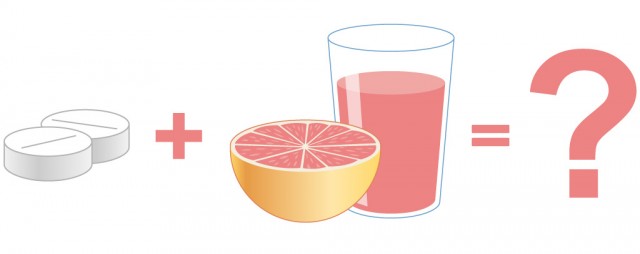
Mixing medication and grapefruit juice isn’t something that jumps to mind as being dangerous, but depending on the drug involved, it can be lethal.

Grapefruit contains bergamottin, dihydroxybergamottin, bergapten and bergaptol, chemicals that act as a natural defence mechanism against pests. These chemicals, part of a group of chemicals called furanocoumarins, interfere with an enzyme called CYP3A4 found in the liver and intestine. This enzyme plays a critical role in how the body metabolises xenobiotics, chemicals that are not naturally occurring in the body and which aren’t normally found there.

The action of grapefruit juice on CYP3A4 affects a large variety of drugs, including sedatives, painkillers, immunosuppresants, statins and artificial hormones. The effect of grapefruit juice can be either an overdose or an insufficient dose, depending on the action of the CYP3A4 enzyme on the particular drug.

The discovery that grapefruit juice could interact with drugs was made by mistake when researchers investigating how alcohol interacted with a drug called felodipine used grapefruit juice to mask the taste of the alcohol. Their results did not tie in with other trials involving felodipine and led to their suggestion that this was “possibly due to a pharmacokinetic interaction with the grapefruit juice vehicle”.1 Luckily for those of us that enjoy grapefruit, scientists at the University of Florida are already working on breeding a low-furanocoumarin grapefruit.2

1 D.B. Bailey et al, “Ethanol enhances the hemodynamic effects of felodipine”, Clinical and Investigative Medicine 12(6) (1989): 357-362. PMID: 2612087.

2 Chunxian Chen et al, “Characterization of Furanocoumarin Profile and Inheritance Toward Selection of Low Furanocoumarin Seedless Grapefruit Cultivars”, Journal of the American Society for Horticultural Science 136(5) (2011): 358-363. Link.

Specific heat, latent heat and scalds

Why is being scalded by boiling steam so much worse for you than being scalded or burnt by a liquid or a solid at the same temperature?

The specific heat capacity of a material measures how much energy is required to change the temperature of that material. The specific heat capacity of water is 4180 joules per kilogram per kelvin, meaning that it requires 4180 joules of energy to raise the temperature of one kilogram of water by one kelvin.

The latent heat of a material is the energy required to change the state of a material without changing the material’s temperature. There are therefore two latent heats: the latent heat of fusion is the energy required to turn a solid to a liquid or vice versa, and the latent heat of vaporisation is the energy required to turn a liquid to a gas or vice versa. For water the latent heat of fusion is 334 000 joules per kilogram and the latent heat of vaporisation is 2 260 000 J/kg.

If a one gram drop of boiling water (at 100°C) falls on skin at a temperature of 35°C then the temperature of the water quickly falls by 65°C. To drop the temperature of one gram of water by 65°C requires a change in energy of 272 joules. Because heat always flows from a hotter body to a colder one* this heat flows into the skin, damaging skin cells as it does.

The situation is different if one gram of boiling steam (still at 100°C) hits the skin. First it has to change state into water, and then cool down just as above. In the process of changing state from a gas at 100°C to water at 100°C it releases a huge amount of energy: an additional 2260 joules when compared with the 272 joules released as it cools. If we assume that the severity of the scald is proportional to the energy released (which is a very reasonable assumption) then a scald with boiling steam does 931% of the damage that a scald with boiling water does.

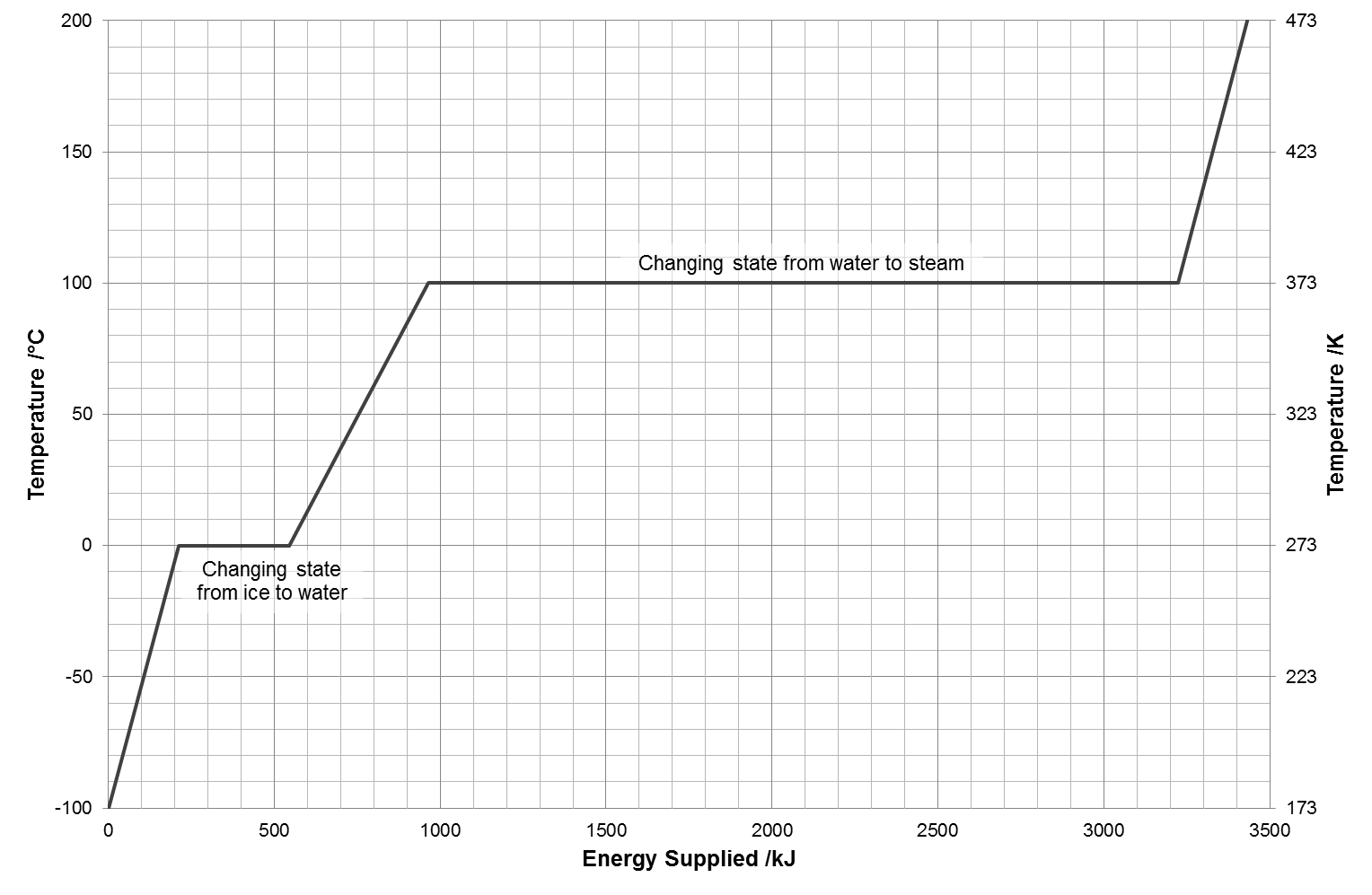
The graph above shows how the temperature of a 1kg block of ice at −100°C changes as energy is supplied to it. The horizontal sections occur when energy is being absorbed but the temperature of the substance is not changing; this is because the energy is being used to weaken bonds between molecules as the state changes first from solid to liquid and then from liquid to gas. The longer horizontal section in the liquid-gas state change indicates that more energy is required to turn water into steam than is required to turn ice into water. This is reflective of the relative strengths of the intermolecular bonds in solids, liquids and gases. The differing gradients of the sloped sections reflects the fact that the specific heat capacity of water varies with state.†

* More accurately, the net flow of heat is always from a hotter body to a colder one.

† For the sake of simplicity, the specific heat capacity of water in each state has been assumed not to vary.