Category Archives: General

Osteoporosis

Osteoporosis is a disease that causes the density of bones to decrease. Normally bones are constantly being remodelled – some of the bone is broken down (resorped) and new bone grows in its place. In a normal person about ten percent of bone at any one time is undergoing this process. If there is a different in the rate of the two processes, with resorption occurring faster than growth, then osteoporosis will develop.

The two micrograph images below, from the Wellcome Collection, demonstrate the difference very clearly.

Normal Bone

Osteoporotic Bone

The holes in bones are required so that nutrients can get to the bones and also to give bones some “give” so that they are not too brittle; it’s important for bones to be able to bend a small amount to absorb shocks.

Solved games

It might seem odd to describe a game like Draughts (US: Checkers) as being solved, but mathematically and scientifically it makes perfect sense.

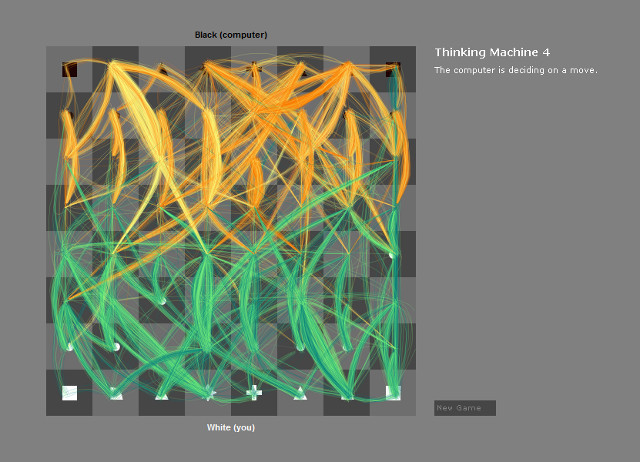
A screenshot showing the Thinking Machine 4 chess engine deciding on a move.

A game is described as solved if it is possible for a player with knowledge of the solution to play a perfect game – to win (or at least draw) every time, no matter what moves their opponent makes. Theorists describe a game as being solved in two ways: a weak solution provides a fail-safe method from the game’s standard starting positions (e.g. in chess with all pieces on their “home” squares) and a strong solution provides a fail-safe method given any starting point.

The largest game solved so far is Draughts. It was weakly solved in April 2007 by a team led by Jonathan Schaeffer*, and their solution was implemented in a computer Draughts program called Chinook. It is mathematically impossible to play Chinook at Draughts and win – the only possible options are to lose or draw (if you don’t believe me, you can play against Chinook online).

Not all solved games result in a draw. In Connect Four the first player can force a win, whereas the second player will always win if playing Sim/Hexi or Chopsticks.

There are many important games that remain unsolved. Chess is only partially solved (for three to six piece endgames) and Go, perhaps one of the most computationally complex games, is only solved for board sizes up to five-by-five (standard games take place on a nineteen-by-nineteen board). It is estimated that with current technology it is impossible to solve either of these games.

This post was inspired by the excellent Relatively Prime podcast’s episode about Chinook.

* Jonathan Schaeffer et al, “Checkers is Solved,” Science 317 (2007): 1518-1522. DOI: 10.1126/science.1144079.

Earthquake cloak

Metamaterial cloaking, the idea of hiding an object using special materials, has become a popular area of research in recent years. Optical cloaks attempt to hide objects from visible light, thus making them invisible. Audible cloaks attempt to hide objects from sound waves, thus making them undetectable by (for example) sonar. Attempts at cloaking also exist for other waves; for example trying to make objects invisible to radar, which has obvious military applications.

If cloaking can work for electromagnetic and sound waves then it may also be possible to make it work for seismic earthquake waves.

The metamaterials used in cloaking have negative refractive indices and so waves do not travel through them in the normal way. All metamaterial cloaking methods work by bending waves around an object and returning them to their original paths, so that it appears that the object was never there. If the same thing could be made to happen for seismic waves around a building, then it could completely isolate the building from the seismic waves’ destructive effects.

In February of this year Sang-Hoon Kim of Mokpo National Maritime University in South Korea and Mukunda Das of the Australian National University in Canberra proposed* a way of doing this. Their method involves creating sixty metre-wide “shells” of specially constructed concrete pillars in the ground around a building, and unlike previously suggested methods doesn’t involve aiming or deflecting the waves at other buildings in the area. They suggest that their method would be able to absorb the energy of the earthquake waves, essentially stopping the waves in their tracks by transferring their energy into sound and thermal energy. A later paper†, by the same authors suggests using a similar method to create an artificial “shadow zone” in which the earthquake waves are not felt.

* Sang-Hoon Kim and Mukunda P. Das, “Seismic Waveguide of Metamaterials”, arXiv:1202.1586.

† Sang-Hoon Kim and Mukunda P. Das, “Artificial Seismic Shadow Zone Created by Metamaterials”, arXiv:1210.5589.

Thanks to KS for the inspiration for this post.

Surviving acceleration

How fast can you accelerate, or decelerate, and live to tell the tale?

In this context, acceleration and deceleration are usually measured in ‘G’s, multiples of the acceleration due to gravity. For example, if you crashed a car travelling at 70 miles per hour into a wall, and it took you one second to come to a stop this would be a deceleration of 35.8 metres per second per second, which is equivalent to an deceleration of 3.65 G. If the person in the car had a weight of 1000 newtons (≈100 kg) they would feel a force pushing them forwards against their seatbelt of 3650 N.

G-forces on the human body are described in two ways*: Gx which is along an axis running horizontally through the chest at a right angle and Gz which is along an axis running vertically downwards through the head and feet. A positive Gx is described as “eyeballs in” and a negative Gx as “eyeballs out”; a positive Gz pushes blood towards the feet and a negative Gz pushes blood towards the head.
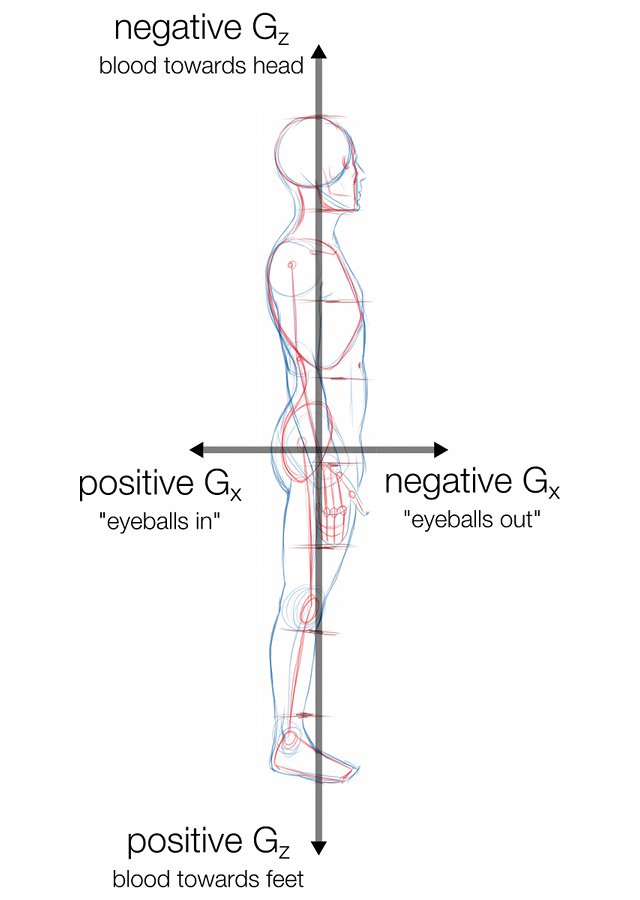
The human body responds differently to acceleration in different directions.
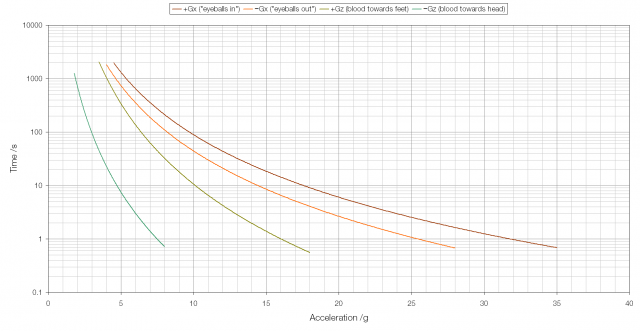
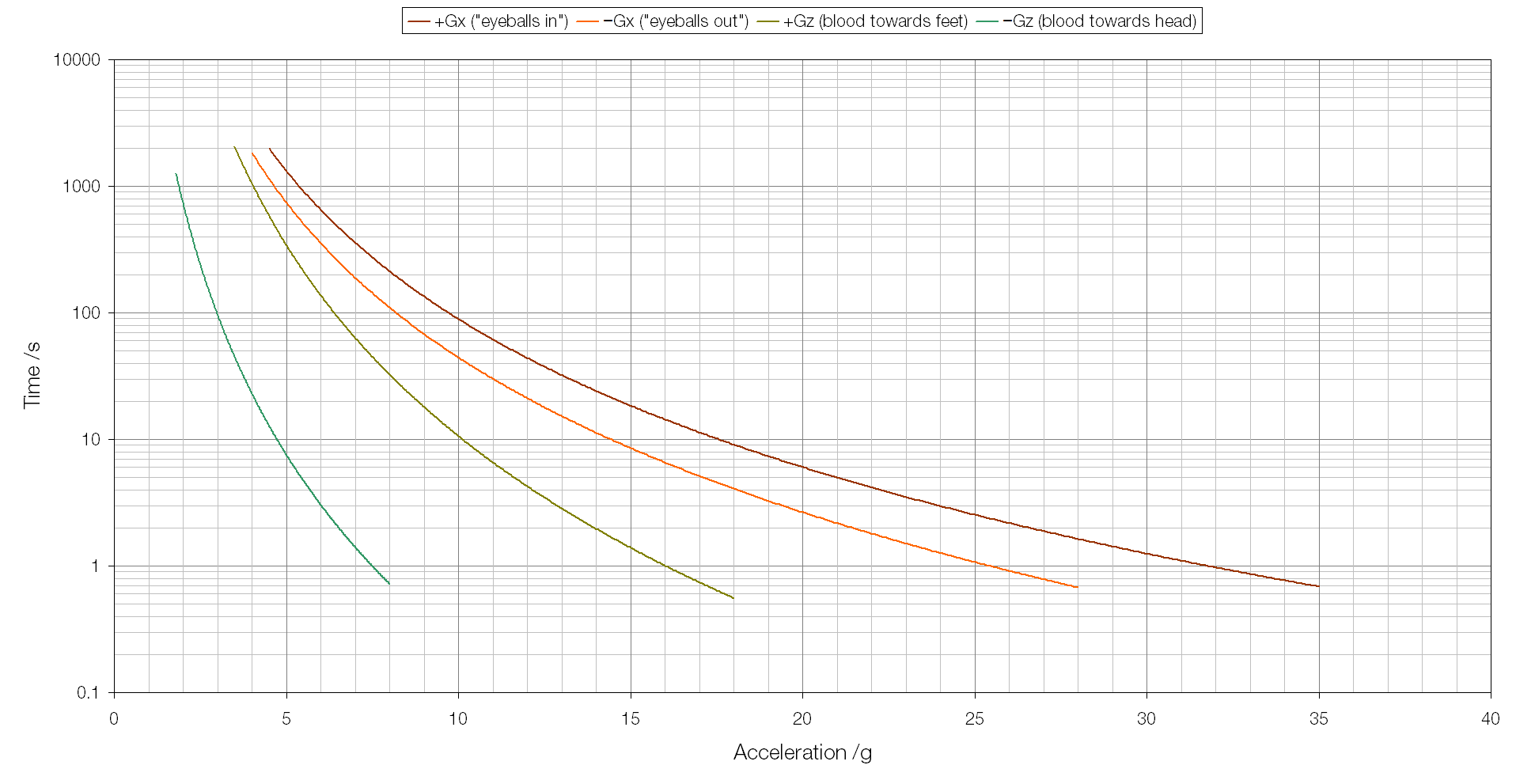
For example: a human being can survive an “eyeballs in” 5G acceleration for about 1500 seconds, but an “eyeballs out” 5G acceleration for only half of that. Moving vertically, with blood towards the feet, a 5G acceleration can only last for 350 seconds before death occurs; but with blood towards the head for only about 8 seconds.

It seems that the human body is least sensitive to “eyeballs in” and “eyeballs out” accelerations, which makes sense when considering that human beings are far more prone to experience these accelerations than others. It’s easier to survive blood rushing to the feet than it is to survive blood rushing to the head, as increased blood pressure in the head can cause blood vessels in the brain to burst.

* It seems that very little work has been done on how the body responds to sideways accelerations.

How are mushroom clouds formed?

Mushroom clouds (perhaps more properly known as pyrocumulus clouds) are traditionally associated with nuclear explosions, but any sufficiently large explosion (for example, a volcanic eruption) will create a mushroom cloud.

The mushroom cloud resulting from the Priscilla test of Operation Plumbbob.

When a large explosion occurs a cloud of very hot gas is created. This hot gas, being less dense than the surrounding air, rises rapidly upwards. As this cloud of hot gas rises it pushes against the air above it and this air resistance causes the top layer to move sideways whilst the hotter gas below continues rising upwards, creating a swirling doughnut-shaped vortex (in the photograph above a very hot “filament” is visible at the centre of this vortex). As the “cap” rises this swirling vortex pulls in cooler air from ground level, creating the “stalk” on which the cap sits.

The formation of a mushroom cloud during the Tumbler-Snapper series of nuclear tests.

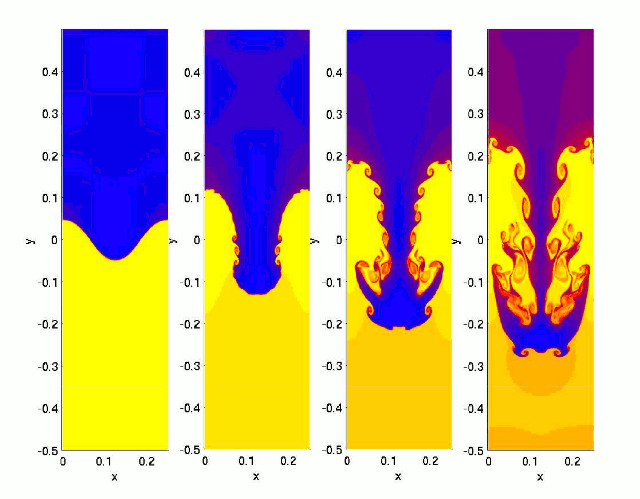
The shape of a mushroom cloud is the result of a Rayleigh-Taylor instability at the interface between the hot less-dense and cold more-dense air. These instabilities occur in a number of different situations, and can be easily demonstrated at home by dropping coloured oil into water, creating tiny upside-down mushroom clouds as shown below in photographs by James Riordon of AIP.

The simulated formation of a Rayleigh-Taylor instability.