Circular objects roll because a circle is a shape of equal width. No matter where you measure from, the distance from one side to the other (through the centre) is the same. But circles aren’t the only shape with this property.
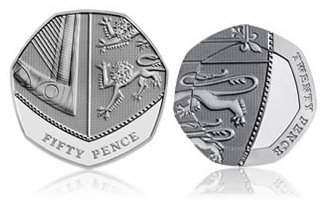
Two British coins are shapes of equal width: the 20p (21.4 mm) and 50p (27.3 mm) coin. Having an equal width makes the coins able to roll and prevents them from getting stuck in machinery. Shapes of equal width also make good manhole covers; because no “side” is any shorter than any other, it is impossible for the cover to fall down the manhole. Circles are easiest to make which is why most manhole covers are circular.

I recall going to a math talk on the topic of shapes of equal-width. If I recall correctly, there is some non-trivial computational problem associated with such objects. Perhaps it is the difficulty in quickly determining whether a given 2D object is a circle (rather than a non-circle with uniform width).
I happened to be discussing shapes of equal width with my wife on Sunday afternoon (maths teacher) and I posed the question of what path the centre of mass takes (height as a function of displacement as it rolls along a surface). Having worked myself into a dead-end a google search ended up leading me to stumble on your blog, where I recognised you from PTNC. Nice to see that physicists can enjoy the pure side of maths as well as the applied.
Obviously the opposite edge will remain at a fixed height. It only came about as I know that these are used in some bearings and wondered if the CofM moving around (in some form of cycloid?) would cause unwanted oscillations.
The rather nice idea of how to design a road for these shapes also came up. Some thoughts on both the questions here http://math.stackexchange.com/questions/8750/reuleaux-rollers and an animation here http://whistleralley.com/reuleaux/reuleaux.htm
3D solids of equal width are also possible http://www.youtube.com/watch?v=jYf3nOYM_mQ
You can also make your own shape of equal width using this as an example http://kmoddl.library.cornell.edu/math/2/
Lovely. It was seeing the Releaux rotor in action that prompted this post.
How much can you get for the coins
I don’t understand your question.