Some people refer to the rainforests as “Earth’s lungs”. In reality this is quite far from the truth, as rainforests actually contribute little (net) oxygen to Earth’s atmosphere; 70% of oxygen production is done by water-bourne green algae and the cyanobacteria present in every habitat on Earth.
Biosphere 2, a sealed ecological system built in Arizona to study the interaction between different forms of life and as a test of the possibility of using closed systems in space colonisation, also had lungs.
Biosphere 2’s oxygen came from the facility’s six biomes: a 1900 square meter rainforest, an 850 square meter “ocean”, a 450 square meter mangrove wetland, a 1300 square meter savannah grassland, a 1400 square meter fog desert and a 2500 square meter agricultural system.
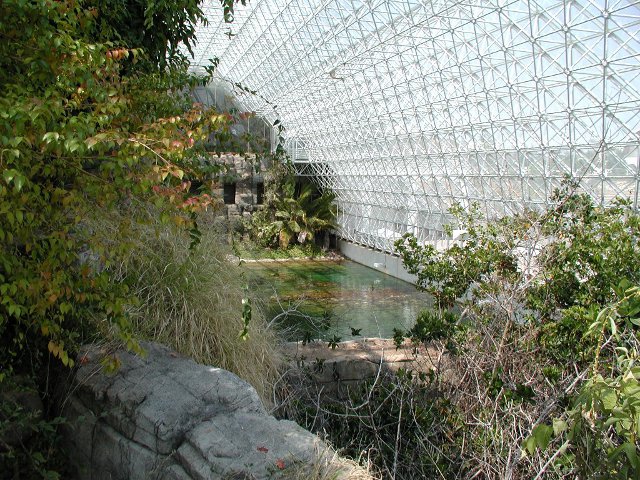
During the day the heat of the Arizona sun would cause the air inside the facility to expand. In order to avoid the large pressure difference that this would create (5000 Pa, or 5% of standard atmospheric pressure), Biosphere 2’s creators included two giant hemispherical “lungs”.

As the air inside the facility expanded it would flow through underground tunnels into the lungs. Each lung contained a large weight hanging from a rubber sheet; as the air expanded during the day the increased pressure would raise the weight into the air. In the evening, as the air cooled, the weight would pull the rubber sheet back down and push air back into the facility, thereby equalising any pressure difference as it appeared.

Source: lumierefl
William Dempster, “Biosphere 2 engineering design”, Ecological Engineering 13 (1999): 31-42 doi:10.1016/S0925-8574(98)00090-1 (.PDF).
I’m not a science buff at all (failed every course I ever took at least once) but this is beyond-fascinating. THANK YOU !