“It doesn’t matter how beautiful your theory is, it doesn’t matter how smart you are. If it doesn’t agree with experiment, it’s wrong.”
— Richard Feynman
In science we first observe a phenomena (e.g. the Moon orbiting Earth) – and then come up with a hypothesis (e.g. objects with mass attract each other) to explain it. That hypothesis is then tested by experiment; if the evidence from the experiment contradicts the hypothesis then it is disproved and must be rewritten. If the evidence does not contradict the hypothesis then it is supported, not proved.
All the evidence in the world cannot prove a hypothesis, whereas only one piece of evidence is needed to disprove it. It would only take one instance of something “falling” upwards to disprove the theory of gravity.
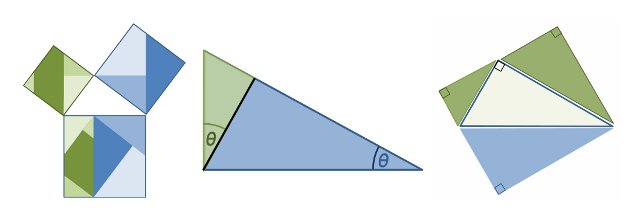
In maths the situation is very different: once something has been proved, it is proved forever. No further research is necessary, no tests need to be performed. Pythagorus’s theorum about the lengths of the sides of right-angled triangles has been proved in many different ways (Cut the Knot has 84 different proofs), but will never be disproved.