Update: The last of the replacement magnets are now underground.
Update: CERN have released another update about the damage. It uses phrases like “internal splice resistance of 100 nano-ohms” and “It has also been a good week for cryostating in SMI2” so it’s really only for those who are particularly interested.
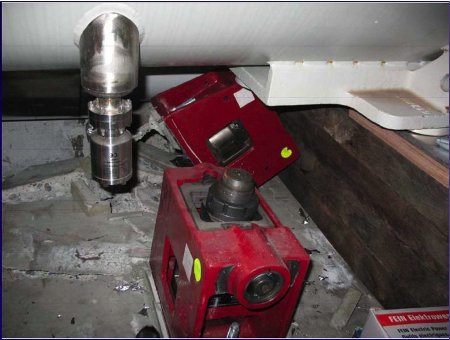
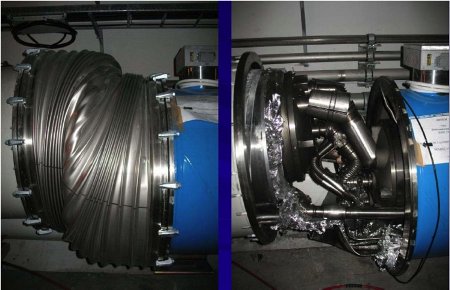
Update: The first images of the damage caused have been released.
The first image shows a magnet that has wrenched itself free from its mountings and the second shows an example of the damage caused when the magnets shifted relative to each other.
Update: CERN’s analysis of the incident is now on-line.
You may have heard that there are problems at CERN and that the Large Hadron Collider has been shut down.
What happened?
The proton beam is steered through the LHC tunnel by more than 1000 superconducting electromagnets. In order to produce the very strong magnetic fields needed to steer and focus the proton beams there must be a very high current flowing through the magnets; if the magnets weren’t superconducting then this would be impossible due to the energy loss involved.
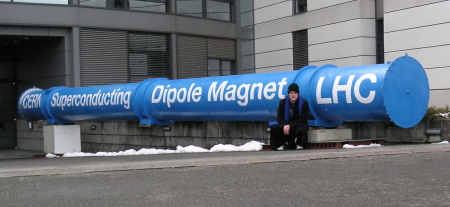
Mr Reid with a superconducting dipole magnet at CERN.
It looks like part of the power “bus” that passes current from one magnet to the next a 12 million volt transformer overheated and melted, releasing about 1000kg 2000kg of liquid helium coolant into the LHC tunnel. Without the helium coolant the magnets heated up beyond their critical temperature and stopped being superconducting – they “quenched” – and this caused them to get really hot, really quickly. This is a Very Bad Thing and resulted in the LHC being shut down.
You can monitor the LHC’s current cryogenic status via CERN’s LHC website.
Update: Lyn Evans, head of the LHC project, has talked about the accident at a CERN meeting. The video is online; Evans begins speaking at about the 9 minute mark.
 mat:
mat: