Category Archives: General

Nuclear Powered X

Where X equals…

Icebreaker

nuclear-icebreaker

The 50 Years Anniversary of Victory is a Russian nuclear powered icebreaking ship, the largest icebreaker in the world.

Lighthouse

nuclear-lighthouse

In the Arctic Ocean and along the remote Kola Peninsula there are at least 130 Russian lighthouses powered by radioisotope thermoelectric generators, fueled by radioactive strontium-90.

Aeroplane

nuclear-aeroplane

The Tupolev-119 was a modified Tupolev-95 bomber with two regular engines and two experimental engines powered by a nuclear reactor in the bomb bay. The bulge created by the enlarged fuselage is clearly visible in the photograph above.

Pacemaker

nuclear-pacemaker

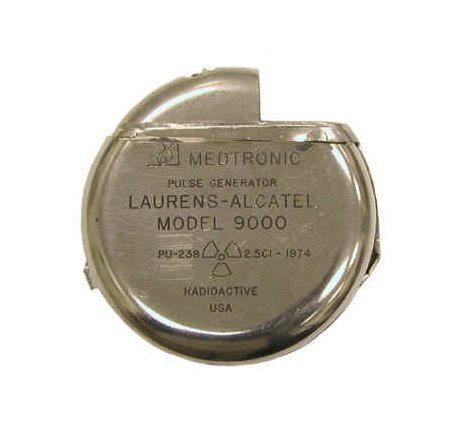
Because pacemakers require surgery to implant it’s a good idea to make the batteries last a long time. The Medtronic 9000 was powered by a radioisotope thermoelectric generator that used a tiny plutonium-238 source and at least one nuclear powered pacemaker is still running 34 years later.

Infrared thermometers and swine flu

One of the symptoms of Influenza A H1N1, also known (incorrectly) as “swine flu” is a fever – increased body temperature. It’s difficult and very time consuming to measure the temperature of every passenger arriving at an airport using conventional mercury-in-glass (or alcohol-in-glass) thermometers but luckily physics has a solution.

Every object with a temperature above absolute zero emits electromagnetic radiation. At around body temperatures this radiation is mainly in the infrared part of the spectrum. By measuring the infrared radiation that a person emits it’s possible to tell how hot that person is.

The Boston Globe’s Big Picture has a series of photographs from the H1N1 outbreak, including two photographs of infrared temperature monitoring in use. In the first photograph you can see technicians in protective suits carrying infrared thermometers; the four dots seen on the patient’s head are used to indicate the area being sampled.

infrared-thermometer-swine-flu

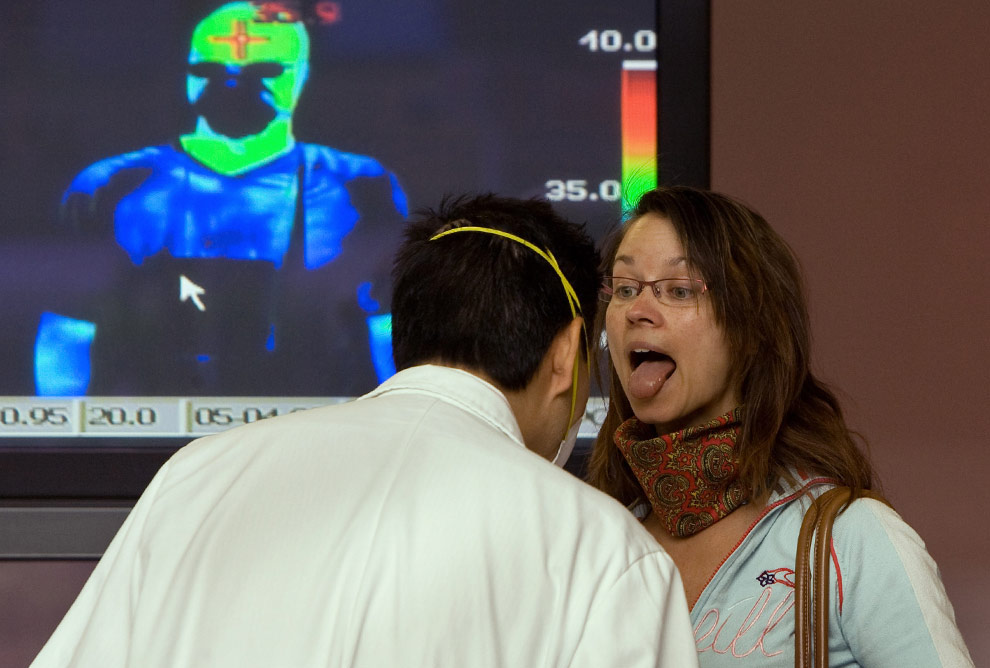
In this second photograph you can see an infrared thermogram in the background whilst a patient’s mouth is examined.

infrared-thermometer-swine-flu2

A cautionary tale

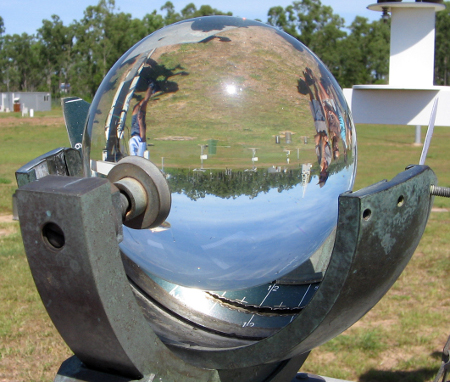
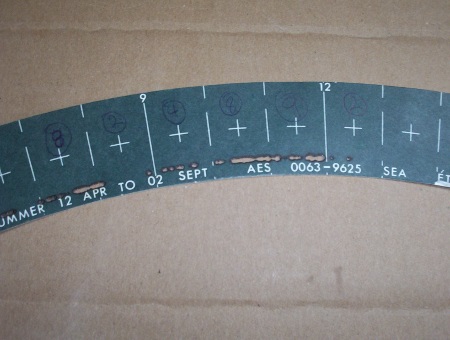
If you’ve ever been involved with weather monitoring you’ll know that a spherical lens can focus sunlight to a point. The Campbell-Stokes sunlight recorder counts the hours of sunlight per day by burning a trail across a calibrated sheet of paper.

campbell-stokes-recorder

sun-card

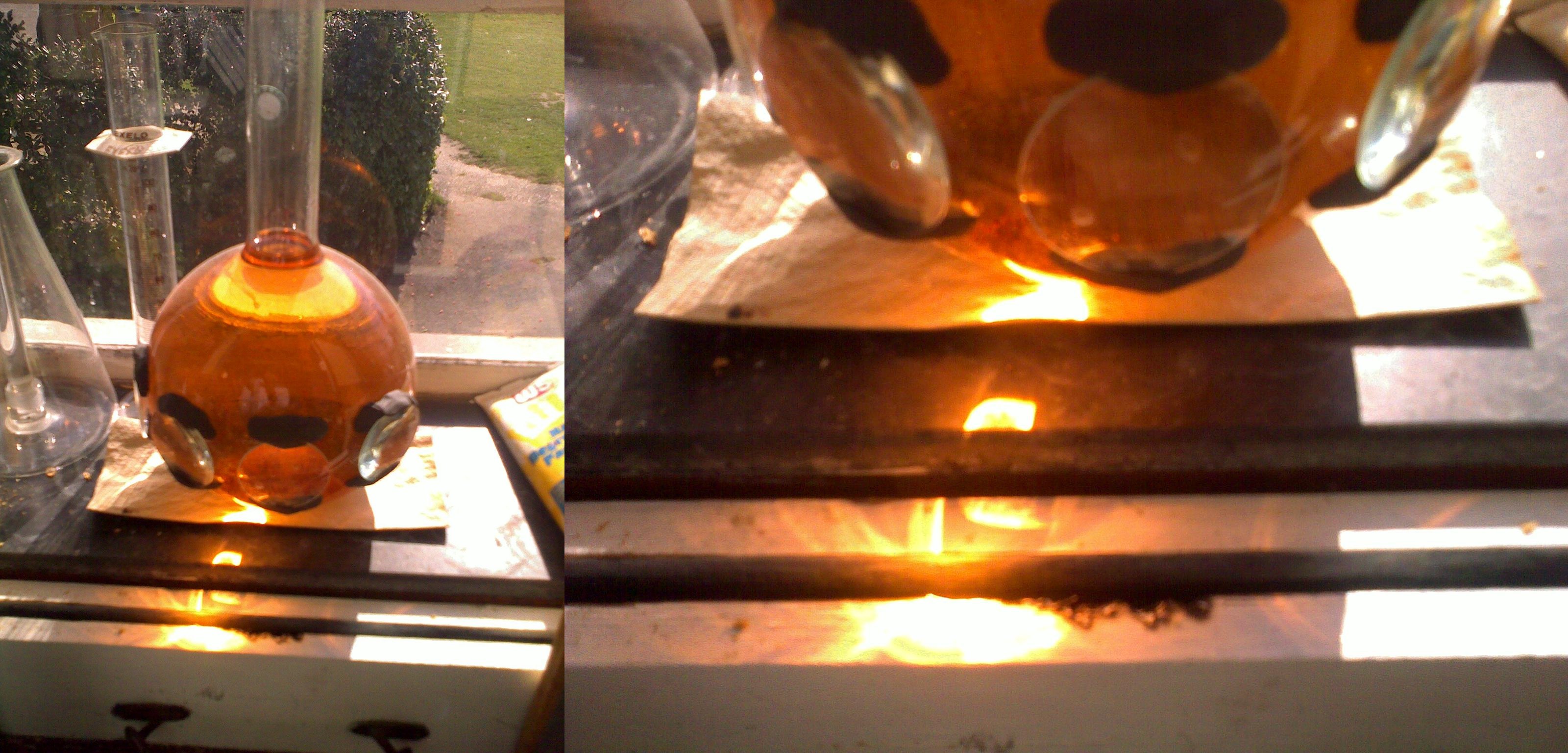
When teaching vision I use a large spherical flask full of dyed water and a number of different lenses to simulate the eye, including short- and long-sightedness.

Until very recently this flask was stored on a windowsill in direct sunlight. Can you guess why we moved it?

spherical-flask-burn

What happened to the LHC?

Update: The last of the replacement magnets are now underground.

Update: CERN have released another update about the damage. It uses phrases like “internal splice resistance of 100 nano-ohms” and “It has also been a good week for cryostating in SMI2” so it’s really only for those who are particularly interested.

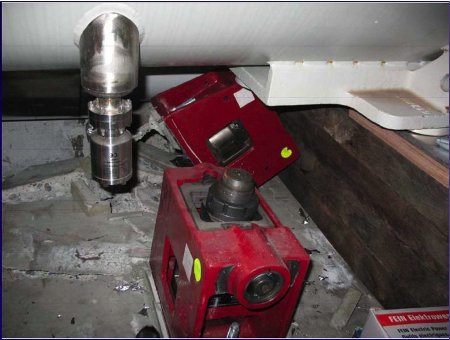
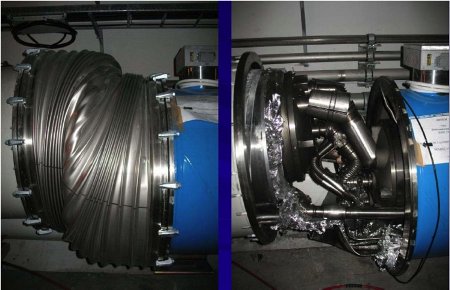
Update: The first images of the damage caused have been released.

The first image shows a magnet that has wrenched itself free from its mountings and the second shows an example of the damage caused when the magnets shifted relative to each other.
Update: CERN’s analysis of the incident is now on-line.

You may have heard that there are problems at CERN and that the Large Hadron Collider has been shut down.

What happened?

The proton beam is steered through the LHC tunnel by more than 1000 superconducting electromagnets. In order to produce the very strong magnetic fields needed to steer and focus the proton beams there must be a very high current flowing through the magnets; if the magnets weren’t superconducting then this would be impossible due to the energy loss involved.
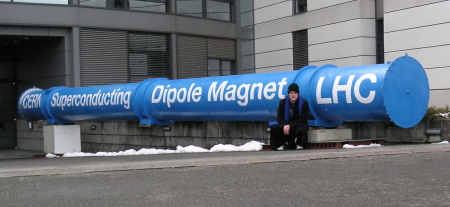

Mr Reid with a superconducting dipole magnet at CERN.

It looks like part of the power “bus” that passes current from one magnet to the next a 12 million volt transformer overheated and melted, releasing about 1000kg 2000kg of liquid helium coolant into the LHC tunnel. Without the helium coolant the magnets heated up beyond their critical temperature and stopped being superconducting – they “quenched” – and this caused them to get really hot, really quickly. This is a Very Bad Thing and resulted in the LHC being shut down.

You can monitor the LHC’s current cryogenic status via CERN’s LHC website.

Update: Lyn Evans, head of the LHC project, has talked about the accident at a CERN meeting. The video is online; Evans begins speaking at about the 9 minute mark.