Category Archives: General

Long half-life ≠ dangerous

Nuclear waste is often quoted as having a “half-life of millions of years” as if this is a bad thing in and of itself.* But there’s another way of looking at it.

Radioactive decay occurs when an unstable atom emits either a helium nucleus, a high-speed electron, an electromagnetic wave called a gamma ray or more rarely one of a number of other possibilities. Being in the way of these emitted particles and waves is generally considered to be a Very Bad Idea.

Radioactive decay occurs at random, with each atom having a chance of decaying at any given moment. The more likely it is that atoms decay, the quicker they decay, and the shorter their half-life.

Imagine the radioactive atoms are ammunition cartridges; when they decay the cartridge “goes off” and a bullet is released. Now imagine you’re standing next to two piles of cartridges representing some nuclear waste: one pile with a short half-life and one pile with a long half-life

The bullets in the short half-life pile will go off over a short period of time, and the bullets in the long half-life pile will go off over a longer period of time. Which pile would be safer to stand next to?

Caesium-135 and caesium-137 are both common isotopes found in nuclear waste: Cs-135 is formed when xenon-135 produced as a fission fragment decays by beta emission; and Cs-137 is formed as a fission fragment itself (a uranium nucleus splits to form one caesium-137 and one rubidium-98 nucleus).

Cs-135 has a half-life of 2.3 million years and emits beta particles with an energy of 267 keV. Cs-137 has a half-life of 30 years and emits beta particles with an energy of 605000 keV. On a graph of 100 years the change in caesium-135 is invisible; only at a scale of a million years does the change become visible:
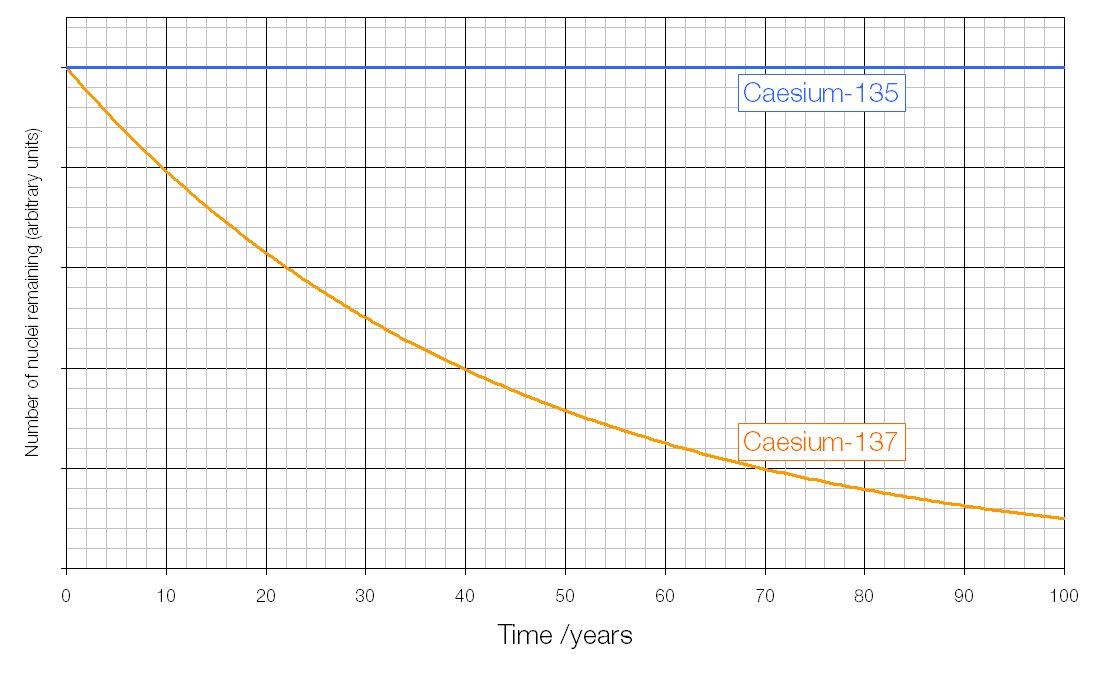
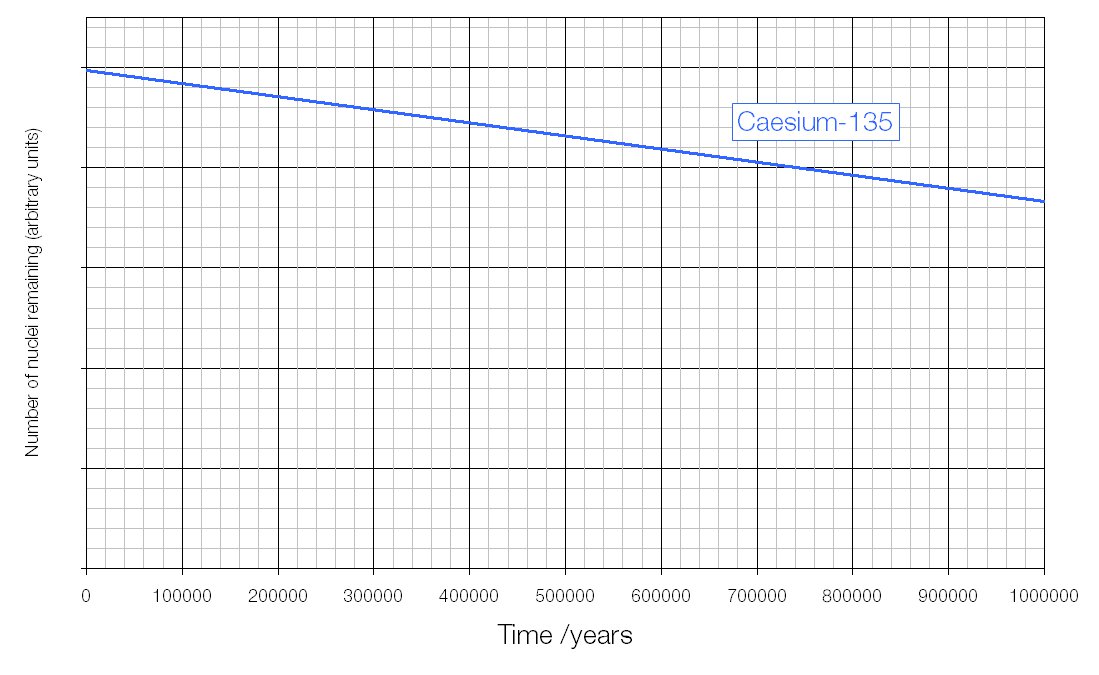
If you stood next to a million atoms of Cs-137 for a year 22840 atoms would decay, for a total energy release of 2.2 nanojoules. Standing next to a million atoms of Cs-135 for a year less than one atom (0.301) would decay and the total energy released would be 13 femtojoules, less than 150 thousandth of the energy released by the caesium-137.

So you have a tradeoff: caesium-135 is less dangerous than caesium-137 but becomes less dangerous more quickly. Both Cs-135 and Cs-137 decay to form stable (non-radioactive) barium so if you can turn a profit selling barium then you’re better off buying a truckload of Cs-137; you’ll be able to sell it as barium sooner.

* It’s worth bearing in mind that nuclear waste eventually becomes safe. Chemical waste from the production of solar cells like silicon tetrafluoride and cadmium telluride remain toxic forever.


Seam Carving for Content-Aware Image Resizing

Resizing an image can be problematic. If you want to make an image larger then you run the risk of creating grainy images with visible pixels. If you want to make an image smaller then you are condemned to lose detail and make features too small to be seen.

Take this image of a bubble. Making it smaller would make the detail invisible; making it larger makes individual pixels too large.

But what if there was a way to remove only the “boring” pixels? Just the ones that do not contribute to the overall image? That’s what Seam Carving for Content-Aware Image Resizing does; it picks out the pixels with the lowest “energy”, those with the least difference between them and their surroundings.

These are the pixels from the image above that the LiquidRescale seam carving plugin for GIMP thinks are the least interesting:

Removing them leaves behind the most interesting pixels:

Which can then be combined into the final, resized image. In this case the image has been shrunk to two-thirds of its original, horizontal size.

Results can be very impressive:

This is why you always put a 1kΩ resistor in series with an LED

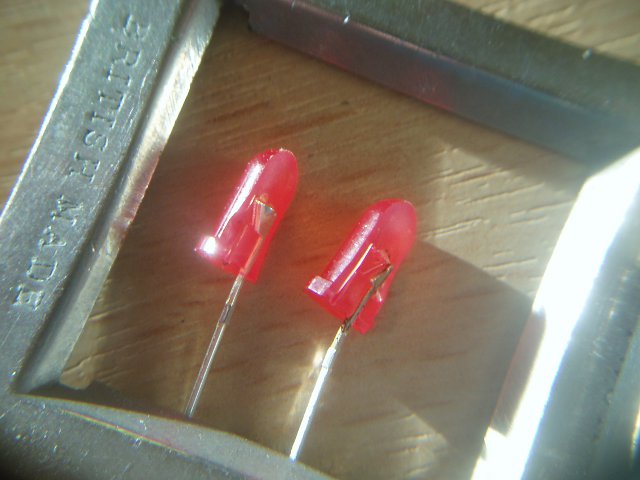
It’s always a good idea to wire a 1kΩ resistor in series with any LEDs you use in order to limit the current, and this is why:

Usually the resistor just burns out, but this LED was entirely different – it split right in half! I’m still not quite sure why, but Occam’s Razor states that it’s more likely to be a manufacturing defect rather than some new phenomenon.

Thanks to my colleague PAS for bringing this to my attention.

Heavier going up, lighter coming down

If you’ve every felt a little bit heavier in a lift going up, or a little bit lighter in a lift coming down, you’re not imagining it.

Imagine standing on a set of scales in a lift. The Earth pulls you down onto the scales and the scales push back on you with an equal force – that’s the force that the scales read.

Einstein’s equivalence principle, part of the framework of general relativity, is that it is impossible to tell the difference between acceleration due to gravity and acceleration due to an external force*. If the lift is accelerating upwards this must be because a force is exerted upon the lift in an upward direction and as this is in addition to the force of the scales pushing upward, you feel heavier.

Some of the world’s fastest elevators, those found in the Taipei 101, go from stationary to 60 km/h in sixteen seconds, which means they accelerate at 1.05 m/s². When this is added to the acceleration due to gravity (9.81 m/s²) it increases the weight of an object by just under 11% – an 80 kg man would feel like he had a mass of 89 kg. When decelerating, the opposite is true – an 80 kg man would feel like he had a mass of 71 kg.

If the lift was accelerating downward quickly enough, at 9.81 m/s², then the person inside would feel completely weightless. This is how weightlessness is simulated in aircraft, accelerating downward in a powered dive at the same rate as gravity.

* Einstein’s equivalence principle is actually about the difference between inertial mass and gravitational mass but the difference isn’t particularly important here.