Category Archives: General

Squat effect

oasis-of-seas

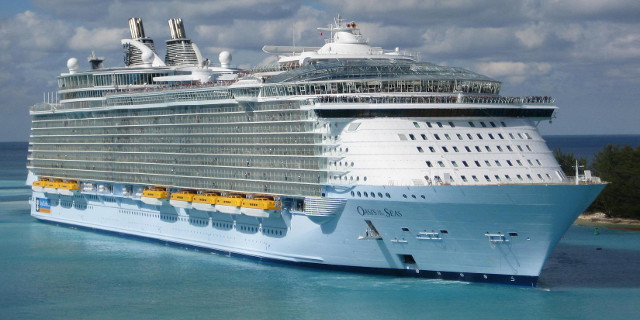
The MS Oasis of the Seas is the world’s largest cruise ship (holding the title jointly with its sister ship, MS Allure of the Seas) and stands seventy-two metres above the water line. During the delivery process, as it was sailing from the STX Shipyard in Finland where it was built to its first stop, it had to pass underneath the Great Belt Bridge that connects the Danish islands of  Zealand and Sprogø, a bridge that stands only sixty-five metres above the waterline. Oasis of the Seas is equipped with telescoping funnels and ballast tanks, but this would only create a tiny margin of safety between the ship and the bridge.

allure-under-bridge

Luckily, the ship was able to rely on something called the squat effect to help it make it under the bridge. The squat effect occurs when a ship moves through shallow water at speed. The water is forced underneath the ship, increasing its speed, and this causes the water pressure to drop (by Bernoulli’s Principle), thereby pulling the ship deeper into the water.
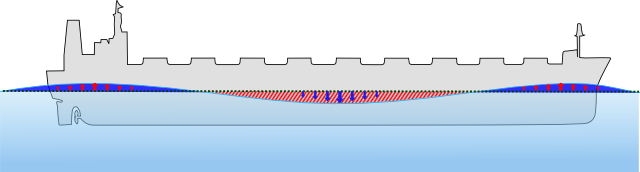
ship-no-squatIn deep water no squat effect is present.
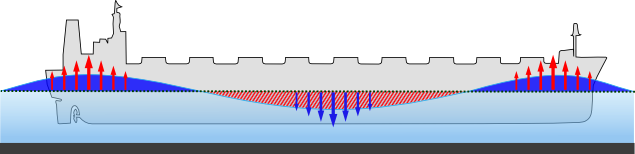
ship-squatIn shallow water the squat effect causes the ship to sink lower into the water.

Oasis of the Seas approached the bridge at twenty knots (10.3 m/s; 23 mph), close to its twenty-two knot top speed and this was enough to pull it an additional thirty centimetres into the water, allowing it to pass safely under the bridge.
FOGBANK

“The material is classified. Its composition is classified. Its use in the weapon is classified, and the process itself is classified.”

FOGBANK is the codename of a material used in modern nuclear warheads such as the W76 used in Trident submarine-launched ballistic missiles, the W78 used in silo-launched Minuteman III intercontinental ballistic missiles and the W80 used in air-launched cruise missiles and the Tomahawk cruise missile.

Exactly what FOGBANK is, and what it does, is unknown. It has been suggested that it is an aerogel-like substance that transfers energy from the fission stage of a thermonuclear (fission-fusion) device to the fusion stage; preventing the fission stage from destroying the fusion stage before it has time to react.

In 1996, during the refurbishment process for the aforementioned warheads, it was discovered that detailed records of the manufacturing process for FOGBANK did not exist, and the facility used to manufacture it had been mothballed.  Uncertain whether alternate materials would suffice, the National Nuclear Security Administration spent twenty-three million dollars on research and new facilities to recreate FOGBANK.

Unfortunately, the Mark II FOGBANK did not work correctly. Eventually it was discovered that this was due to the presence of an impurity, accidentally incorporated into original batches of FOGBANK, that was not included in the second manufacturing process. This impurity was included in the new formula as an additive and the refurbishment process was successful.

The Torino Scale

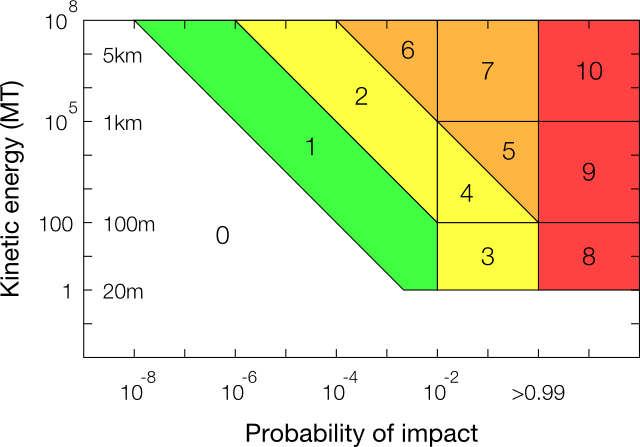
The Torino Scale is a system for categorising the risk presented by near earth objects (NEOs) such as asteroids and comets. On the Torino Scale NEOs are rated on a scale from zero to ten, based on a combination of the probability of an object striking earth and the kinetic energy of that object.

Because orbits are unstable and can change the scale only applies to potential objects less than one hundred years in the future. The diagram below shows the different Torino Scale categories, with a logarithmic scale on both axes and an approximate indication of the diameter of the asteroid on the kinetic energy axis.

torino-scale

The Torino Scale is separated into five categories:

  • White (Torino Scale 0) – No hazard; “the likelihood of a collision is zero, or is so low as to be effectively zero”.
  • Green (Torino Scale 1)Normal; “a routine discovery in which a pass near the Earth is predicted that poses no unusual level of danger … new telescopic observations very likely will lead to re-assignment to Level 0”.
  • Yellow (Torino Scale 2-4)Meriting attention by astronomers; “current calculations give a 1% or greater chance of collision capable of localised [Level 3] or regional [Level 4] destruction”.
  • Orange (Torino Scale 5-7)Threatening; at its most extreme “a very close encounter by a large object, which if occurring this century, poses an unprecedented but still uncertain threat of a global catastrophe”.
  • Red (Torino Scale 8-10)Certain collision; “a collision is certain, capable of causing localized destruction [Level 8] … unprecedented regional devastation for a land impact or the threat of a major tsunami for an ocean impact [Level 9] … or capable of causing global climatic catastrophe that may threaten the future of civilisation as we know it, whether impacting land or ocean [Level 10]”.

As new data about an NEO becomes available the Torino Scale rating for an object can jump suddenly: the Chelyabinsk meteor had a kinetic energy of 0.4 megatons TNT equivalent, giving it a Torino Scale rating of zero, but had it been only a little bit more massive or slightly faster (one megaton) it would have suddenly jumped to an eight.

Currently NASA’s Jet Propulsion Lab’s Sentry system lists only one NEO with a non-zero Torino Scale rating. 2007 VK 184 has a Torino Scale rating of one, but the earliest possible collision date is in June 2048, so we don’t have to start worrying just yet.

The Trestle

The Trestle (or more formally the Air Force Weapons Lab Transmission-Line Aircraft Simulator) is a unique structure built by the US government in the Albuquerque desert and which was used to test aircraft’s resilience against the electromagnetic pulses created by nuclear weapons.

trestle

The Trestle is three hundred metres long and nearly two hundred metres tall and made entirely from wood and glue. The presence of any metal would distort readings from EMP testing and therefore The Trestle does not even use metal nails or braces. It was built from more than fifteen thousand cubic metres of Douglas Fir and Southern Yellow Pine and was strong enough to support the weight of a fully loaded two hundred tonne B-52 Stratofortress strategic bomber.

trestle1

Source

The Trestle was equipped with a two hundred gigawatt, ten megavolt Marx generator and was used to test bomber, fighter and transport aircraft and even long-range missiles. The Trestle programme was shut down in 1991 when computer simulations became good enough to simulate the effects of EMPs and the dried-out, creosote-soaked wood now poses a serious fire hazard.

Efforts are being made to have the Trestle site declared a National Historic Landmark, but these efforts are being hampered by the fact that The Trestle is located on Kirtland Air Force Base. Kirtland houses a number of Top Secret units such as the US Air Force Nuclear Weapons Centre, the 498th Nuclear Systems Wing and the Air Force Research Laboratory and therefore access to the site is highly restricted.

Leap smear

For reasons I have discussed before it is occasionally necessary to add* a leap second to the time, in order to keep the time on Earth in line with Earth’s inconsistent rotation.

Many systems require an accurate time to function correctly and the addition of a leap second can cause these systems to malfunction. In June 2012 the addition of a leap second caused a number of major websites such as Reddit, FourSquare, Yelp, LinkedIn, Gawker and StumbleUpon to malfunction and crash, but Google came up with a unique workaround – the Leap Smear – that prevented this from happening.

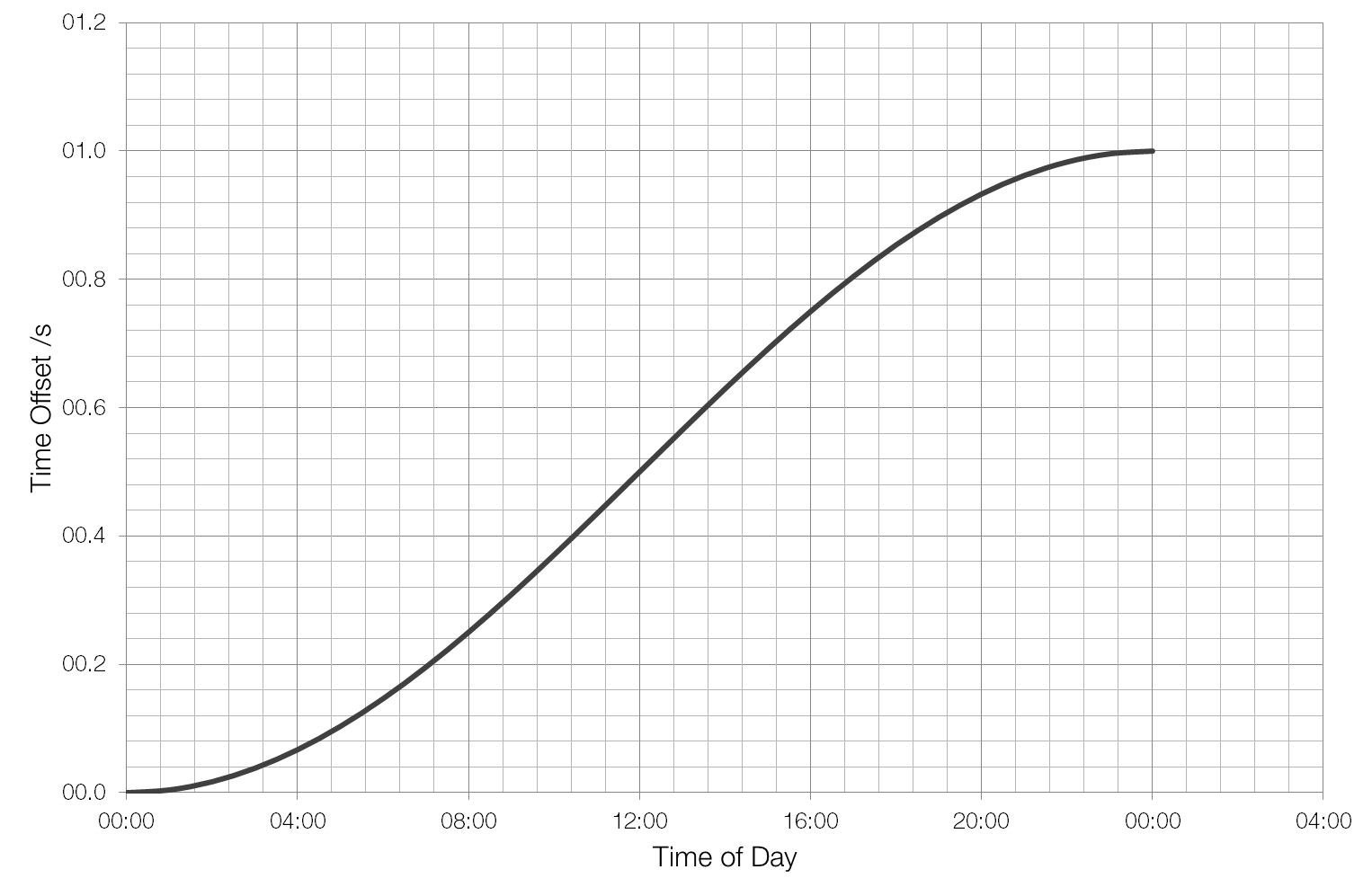
Google, like many others, uses the Network Time Protocol (NTP), to synchronise time across a network.† In order to cope with the leap second problem they configured their NTP servers to gradually add a small fraction of a second over a long period of time (in this case one day) so that at the end of this period their NTP servers’ time would have caught up with the adjusted time.

Google used the following algorithm:

t \left(\textnormal{Google}\right) = t + gain \left( 1 -cos \left( \pi \left( \frac{t}{window} \right) \right) \right)

Where t(Google) is the time according to Google’s NTP servers; t is the actual UTC time; gain is the desired amount of gain time (in this case one second); and window is the time over which this gain should happen (in this case twenty-four hours).

The effect of using the cosine function is such that the time offset is small at first (in the first hour only four milliseconds are added) and gradually increases (to sixty-five milliseconds per hour at most) before decreasing again towards the end of the window.

leap-smear-offset

This prevented servers and devices connected to Google’s NTP servers from “noticing” that something was wrong and applying their own corrections.

As they say in their blog post,

The leap smear is talked about internally in the Site Reliability Engineering group as one of our coolest workarounds, that took a lot of experimentation and verification, but paid off by ultimately saving us massive amounts of time and energy in inspecting and refactoring code. It meant that we didn’t have to sweep our entire (large) codebase, and Google engineers developing code don’t have to worry about leap seconds.

I wouldn’t be at all surprised to see others employing Google’s Leap Smear technique in the future.

* There are also provisions to subtract a leap second, but this has never yet happened.

† The NTP does contain a “leap indicator” but Google decided to force their NTP servers not to apply this.