Category Archives: General

Why does metal feel cold?

One adjective commonly used to describe metals, along with the adjectives like “shiny” and “silvery”, is “cold”.

But this doesn’t makes any sense when you take the Zeroth Law of Thermodynamics into account. Over a long enough period, everything in the same location will tend* to the same temperature, so any metal must be at the same temperature as its surroundings.

So why does metal feel cold?

Metals feel cold because they are very good conductors. Both the metal blade and wooden handle of a shovel left out in the Sun will be at the same temperature but the blade will feel colder because the metal is a good conductor: it “sucks” the heat out of your fingers and this heat leaving your fingers is what makes them feel cold.


Fifteen minute timelapse of melting ice cubes.

In the video above identical ice cubes placed on a wooden board and a metal heatsink removed from a broken laptop computer melt at vastly different rates. The wood is a poor conductor and so the ice cube takes a long time to melt; the opposite is true for the metal heatsink.

* I’m using “tend” in the physics sense of “to approach” rather than the general public sense of “to occur frequently” or “to look after”.
Star traveller etymology

The term astronaut comes from the two Greek words: ástron (star) and nautes (traveller), making an astronaut a “star traveller”. In Russia astronauts have always been known as cosmonauts, an anglicised version of the Russian word kosmonavt (originally from the Greek kosmos meaning “universe”) and the difference between the two terms used seems to have encouraged other nations.

Officially the Chinese use “astronaut” when writing in English and “cosmonaut” when writing in Russian but the term taikonaut (from the Chinese taikong for “space”) has often been used by non-Chinese media.  The French have used spationaut, from the Latin word for space spatium and some have suggested that the Indian space program should use anthanaut from the Hindi anthariksh, also meaning “space”.

Looking at constellations from a different angle

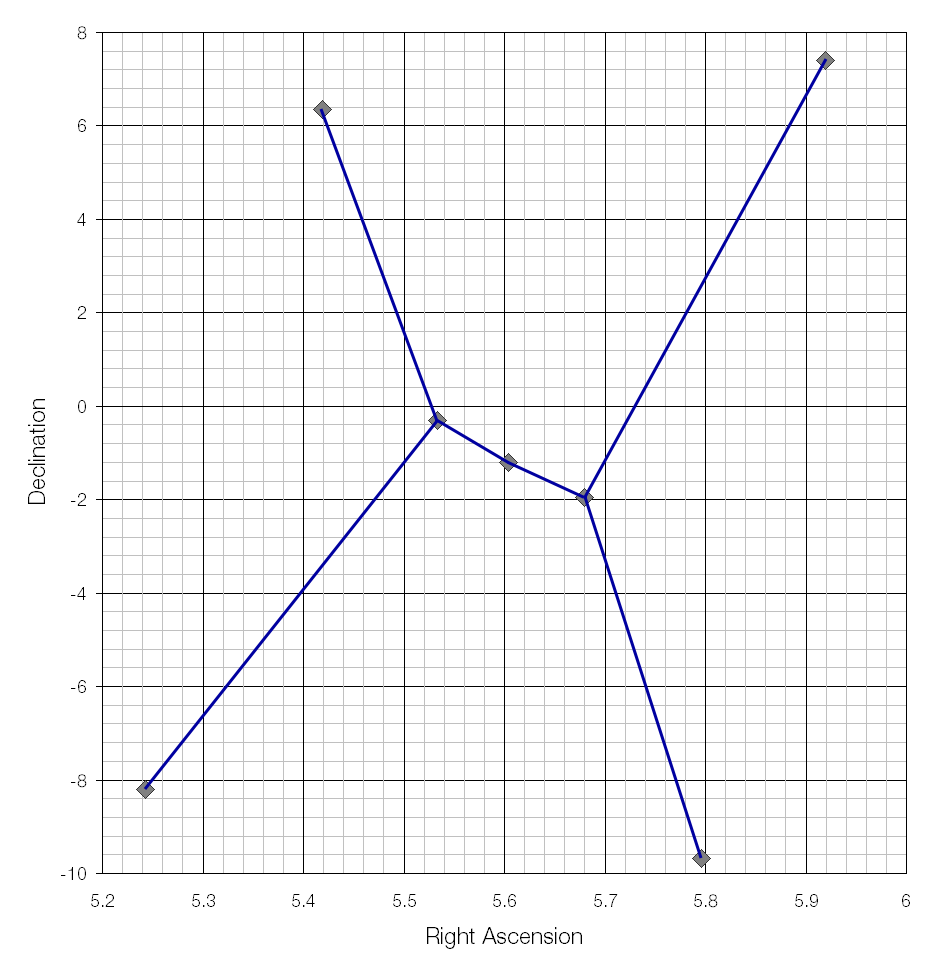
You are probably familiar with the constellation of Orion (The Hunter), in particular with the asterism that makes up Orion’s Belt.

Because of the way the right ascension data is plotted the images shown here are how they would appear to a distant observer looking at Orion towards Earth.

Because stars are so far away we tend to think of them as being painted onto a surface at a fixed distance – “like a huge picture painted on the sphere of the sky”. But if you look at the stars in three dimensions then Orion looks very different.

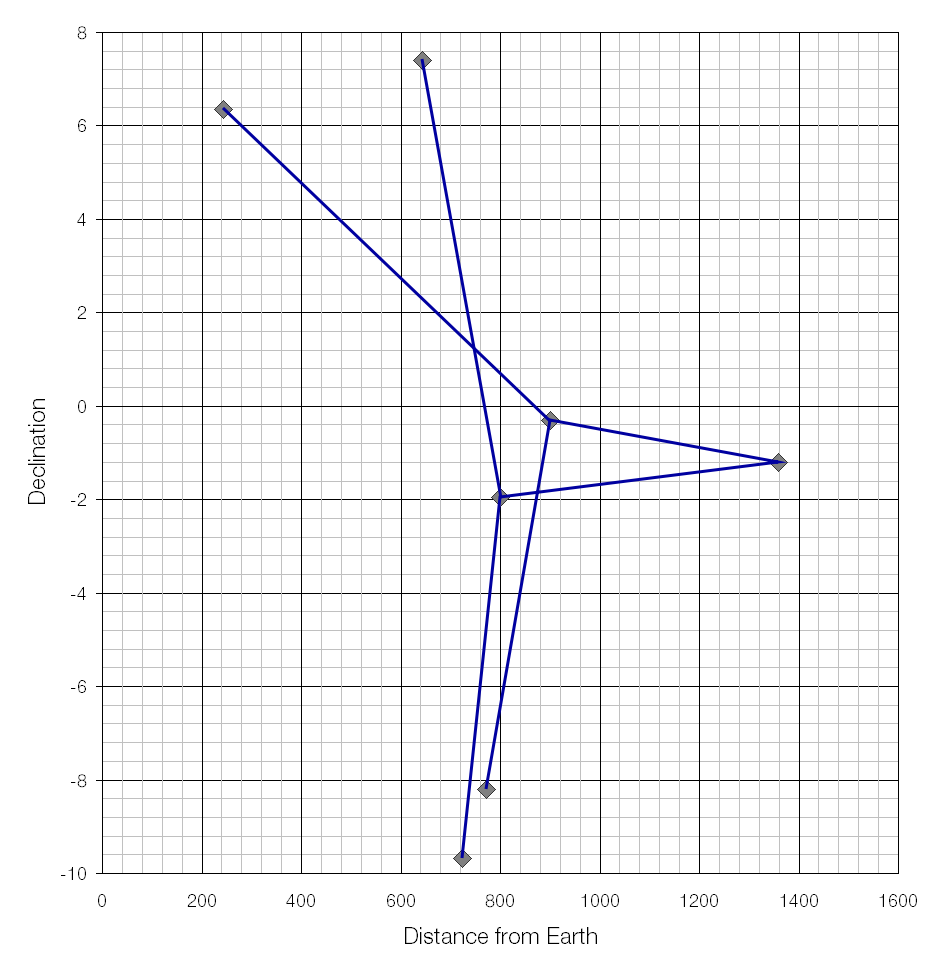
From above it’s difficult to recognise Orion’s shape as the lines connecting the two rightmost stars (Betelgeuse and Saiph) to the rightmost star of Orion’s belt (Alnitak) overlap:

From the side the shape is more obvious. Alnilam, the middle star of Orion’s belt is by far the furthest star, more than 1300 light years away from Earth:

This post was inspired by an arXiv paper* by Dr Daniel Brown from the School of Science and Technology at Nottingham Trent University. You can download the data I used as an Excel spreadsheet (.XLS, 29 kB).

* Daniel Brown (2011) “The Orion constellation becomes installation: An innovative three dimensional teaching and learning environment”, arXiv:1110.3469v1 [physics.ed-ph].

Dating a common ancestor

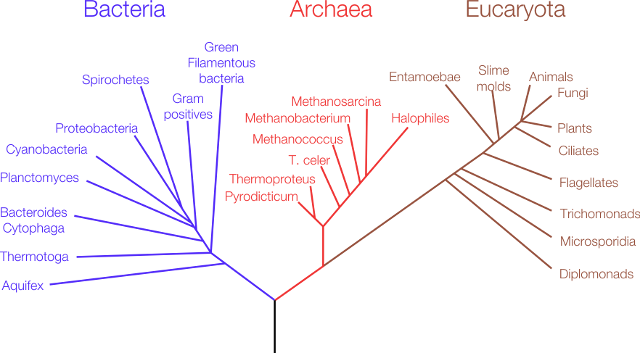
Time Tree is a website that allows you to search for the point in time at which the genetic code of two organisms diverged; the time at which their last common ancestor lived.

Investigating human beings is quite fun: the last common ancestor that we shared with chimpanzees lived 6.3 million years ago and we shared an ancestor with gorillas 8.6 million years ago. We are much closer to cats and dogs (95.2 million years ago) than we are to ducks (292 million years ago).

If we start to look at more obviously different organisms we find much older most recent common ancestors: we shared an ancestor with jellyfish 892 million years ago and with the northern red oak tree 1.43 billion years ago.

It isn’t just humans that you can find the most recent common ancestors for. Horses and camels shared an ancestor 84.2 million years ago and cats and dogs a mere 55.7 million years ago.

R0

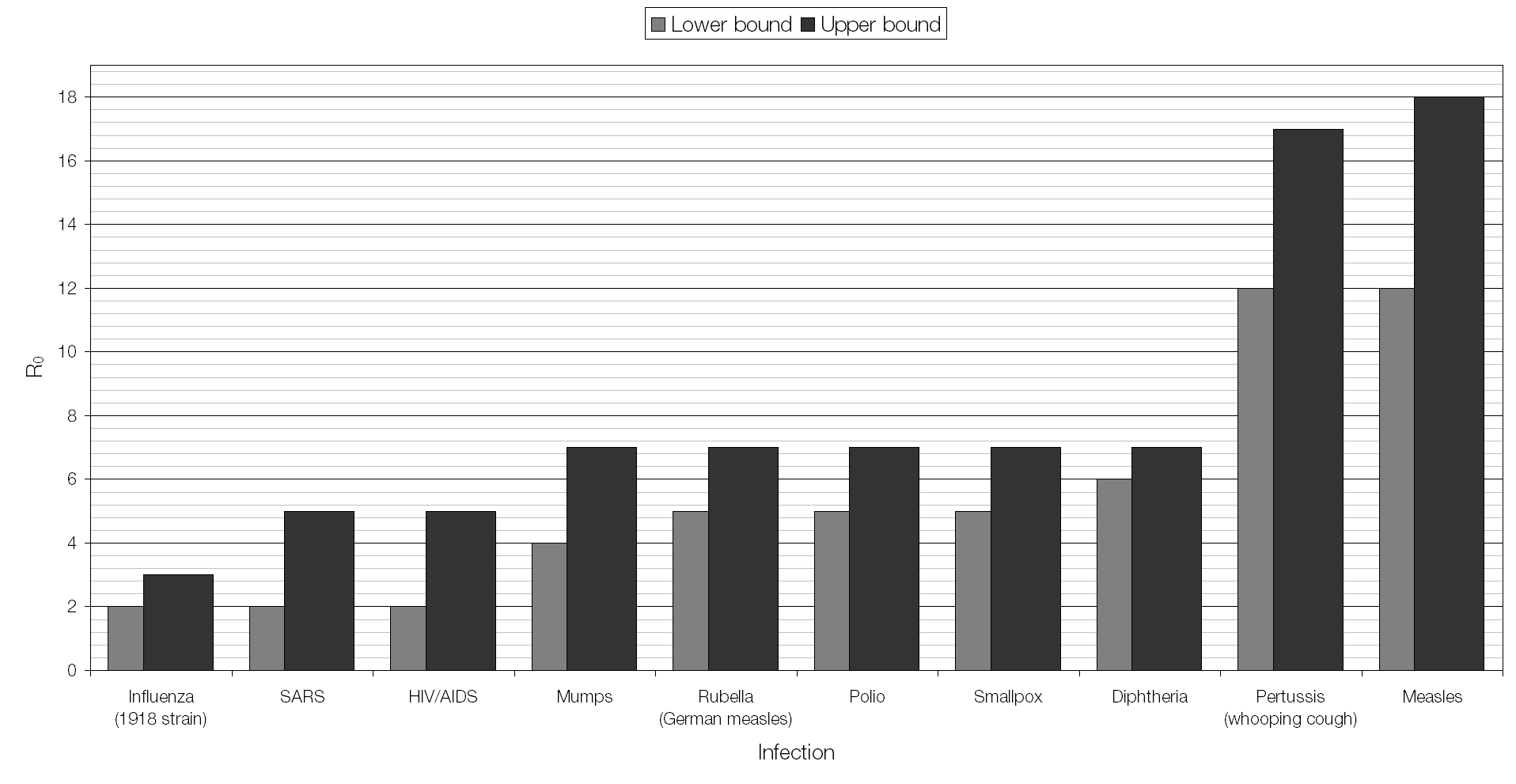
R0, also known as the basic reproduction number, is a measure of the ability of an infection to reproduce and spread in an unimmunised population. If R0 is less than one, each infected person infects (on average) less than one secondary person and the infection will die out. If R0 is greater than one then each infected person infects more than one secondary person and the infection will spread.

R0 varies greatly between diseases:

From the R0 figure the proportion of a population that must be immunised to prevent the spread of a disease can be calculated. If we use the population of the UK (61 838 154 according to 2009 figures from the World Bank) then we get the following graph:

You can see that for the most infectious disease on our list, measles, more than 93% (on average) of the population need to be immunised to prevent the disease from spreading (to prevent an epidemic). This is alarming in light of the failure of many parents to immunise their children due to unfounded fears about the MMR vaccine.