As of today, it has been 10 years since I last posted here, so this site will soon shut down. It’s been emotional.
Category Archives: General
Why is the Earth Hot?
Not on the surface, I mean, but underneath? As you dig down into the Earth’s crust you will find yourself getting warmer, at a rate of about 0.025°C per metre of depth (25°C per kilometre). But why?
There are two sources of internal heat that make up the Earth’s internal heat budget: radiogenic heat and primordial heat. This heat flows to the surface at a rate of around 47 terawatts or 92 milliwatts per square metre of surface. This flow is uneven, with more heat flowing at mid-ocean ridges where two tectonic plates move away from each other, and more heat flowing through oceanic crust (which underlies the oceans) than through continental crust (which underlies continental land). The exact contribution of radiogenic v primordial heat to the total is unknown, but is thought to be approximately 50:50.[1]
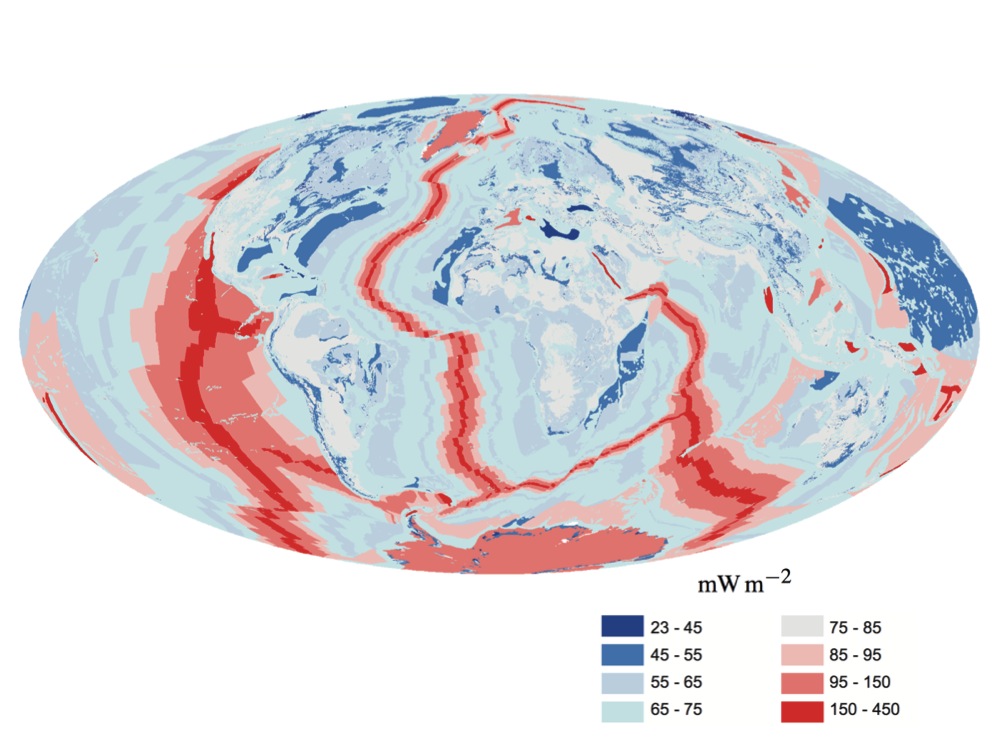
Radiogenic heat is the heat that comes from the decay of radioactive isotopes in the Earth’s crust and mantle; most of it comes from the decay of four isotopes: potassium-40, thorium-232, and uranium-235 and -238.
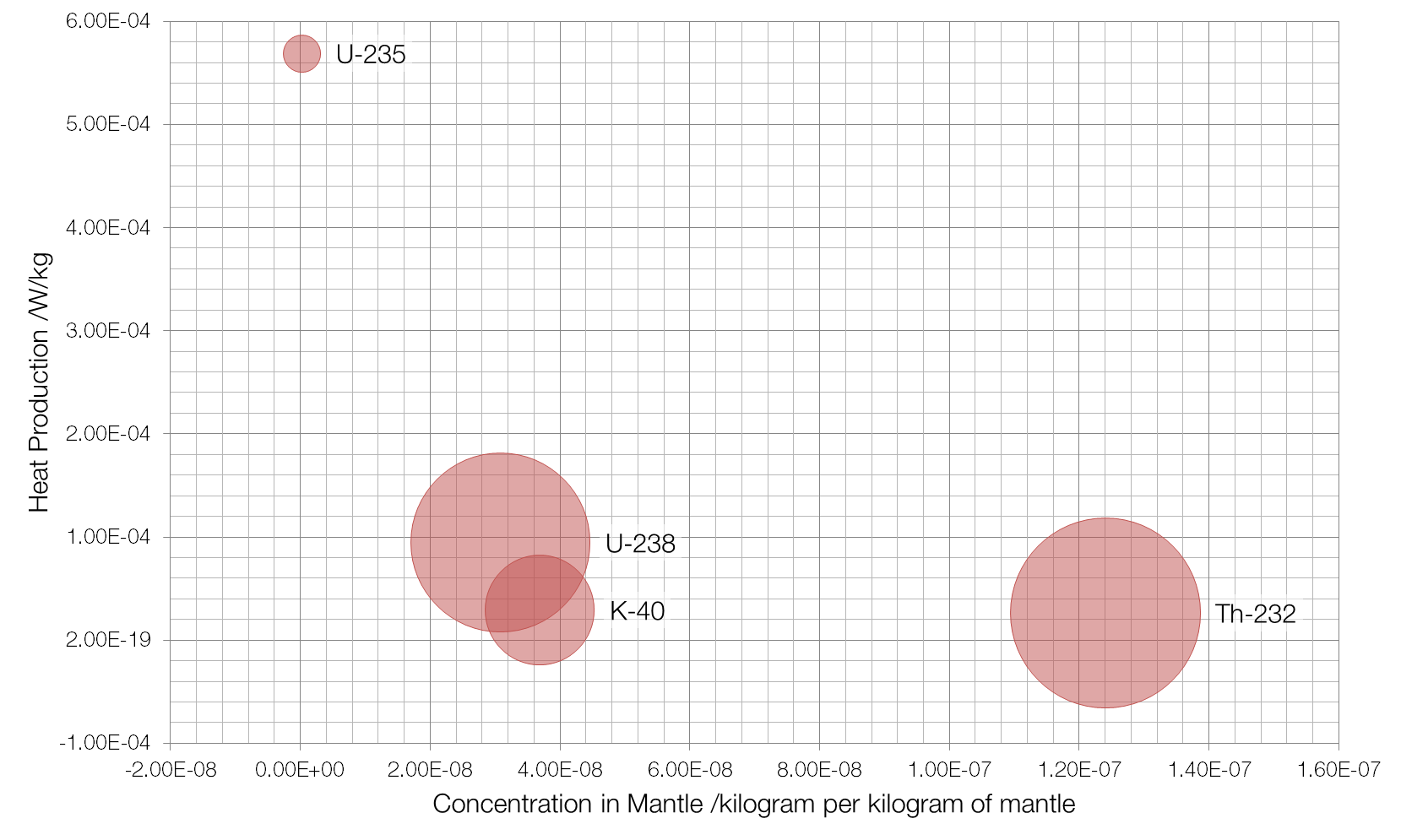
Concentration is on the x-axis, with the more common isotopes further to the right, and the y-axis measures the amount of heat produced by each isotope, with “hotter” isotopes towards the top. The area of the bubble is proportional to the amount of heat that isotope contributes per kilogram of mantle, with thorium-232 contributing the most at 3.3 picowatts per kilogram.
Primordial heat is the heat left over from the formation of the Earth. As gas and dust left over from the formation of the Sun coalesced, they lost gravitational potential energy and gained kinetic/thermal energy. The huge amount of initial heat means that Earth is still cooling even now, 4.5 billion years later.
[1] Gando A, Gando Y, Ichimura K, Ikeda H, Inoue K, Kibe Y et al. Partial radiogenic heat model for Earth revealed by geoneutrino measurements. Nature Geoscience. 2011;4(9):647-651.
Phase diagrams
Everybody knows that water freezes at 0°C and melts at 100°C, right?
Except that’s not always true. The melting point and boiling point of water depends on the pressure of the water: water only freezes at 0°C and melts at 100°C when it’s at standard atmospheric pressure: 101325 pascals. For example, you cannot make a good cup of tea at the peak of Mount Everest because the pressure is lower there and therefore water boils at a lower temperature (around 71°C), lower than the temperature required to properly release the flavour from the tea.
Information about a substance’s melting and boiling points at different pressures can be represented on a phase diagram. The phase diagram for water is shown below:
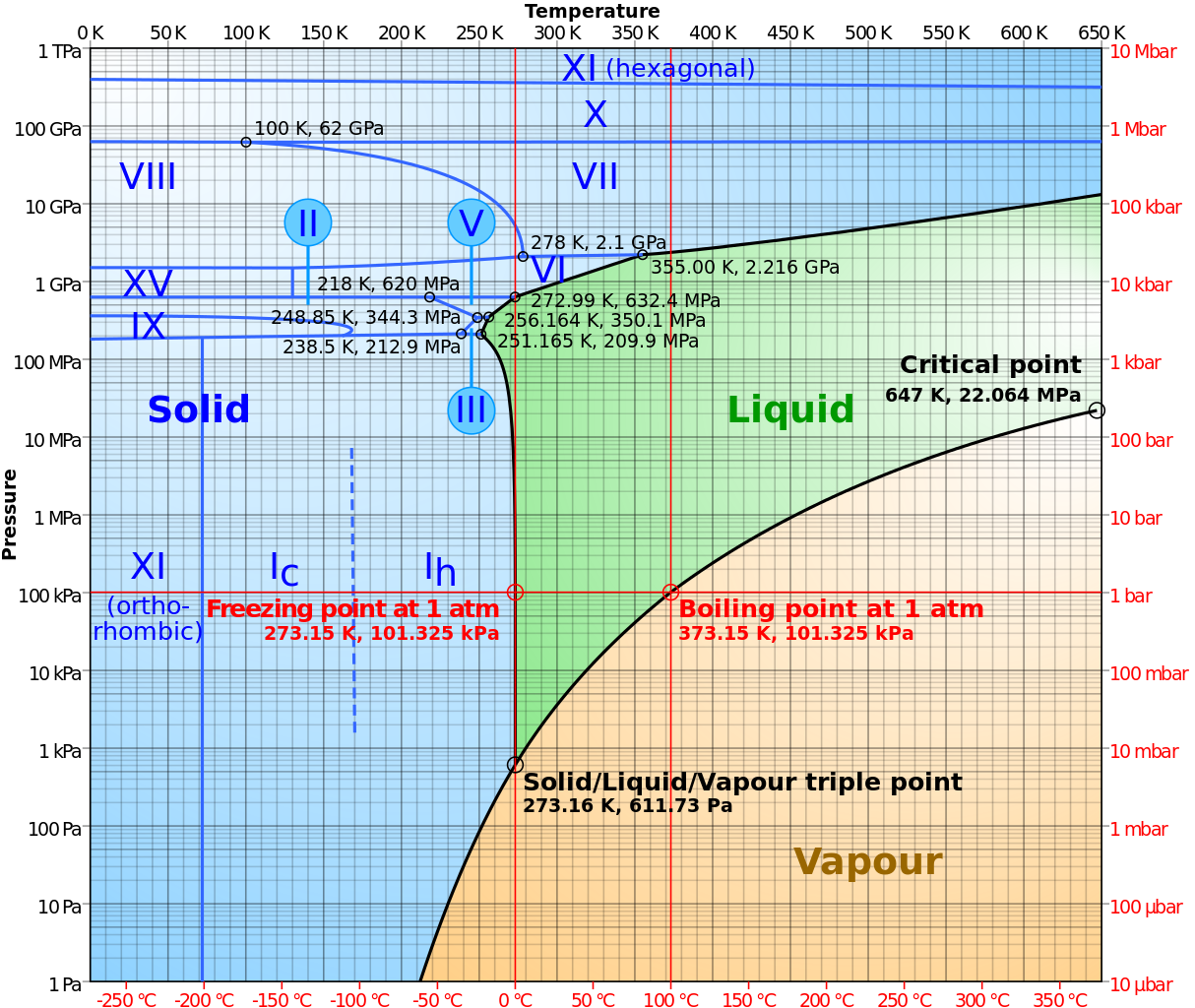
From the diagram, we can see that at pressures below around 600 Pa, water transforms from a solid to a gas without passing through a liquid phase. This is a process known as sublimation, and is most well-known from the carbon dioxide “fog” created when dry ice is placed into hot water. We can also see the triple point, a combination of temperature and pressure (0.01°C and 611.73 Pa) at which ice can exist in all three states simultaneously.
Cyclohexane at its triple point boiling and freezing simultaneously.
At higher pressures, the melting point of water changes. Water can remain as solid ice up to temperatures of more than 300°C when the pressure is above ten gigapascals. What is also interesting is the different types of solid water that are formed at different pressures and temperatures.
One Million Hats
From the always-excellent Futility Closet, a problem by Paul J. Nahin:
Each of a million people puts his or her hat into a very large box. Each hat has its owner’s name on it. The box is given a good shaking, and then each person, one after another, randomly draws a hat out of the box. What is the probability that at least one person gets their own hat back?
Most people might think that the chance is very, very small, but it’s not. It’s actually more than 60%. How can this be true?
We can view this problem as having only two possible solutions (events): either nobody gets their hat back, or at least one person gets their hat back. The sum of the probabilities of these events must be equal to one and therefore if we can work out the probability that nobody gets their own hat back, then the probability that at least one person does is one minus that.
For each person, there is only a one-in-a-million chance that they have picked their own hat, and thus a 999999 in 1000000 chance that they have not got their own hat.



If the probability of all one million people picking the incorrect hat in 0.368, then via our previous reasoning, the probability of at least one person picking the correct hat is 1-0.368, or 63.2%.
This is a very counterintuitive result, but the wording of the question is key. If we changed the wording to exactly one person getting their hat back then our answer changes dramatically. Starting with our 63.2% chance, we would have to subtract the chance of two people getting their hats back, and of three people getting their hats back, and so on … until we reached the very small chance of one person, and one person only, getting their hat back.
Fixed Area, Infinite Perimeter
The Koch Snowflake (named after its inventor, the Swedish mathematician Helge von Koch) is a fractal with a number of interesting properties.
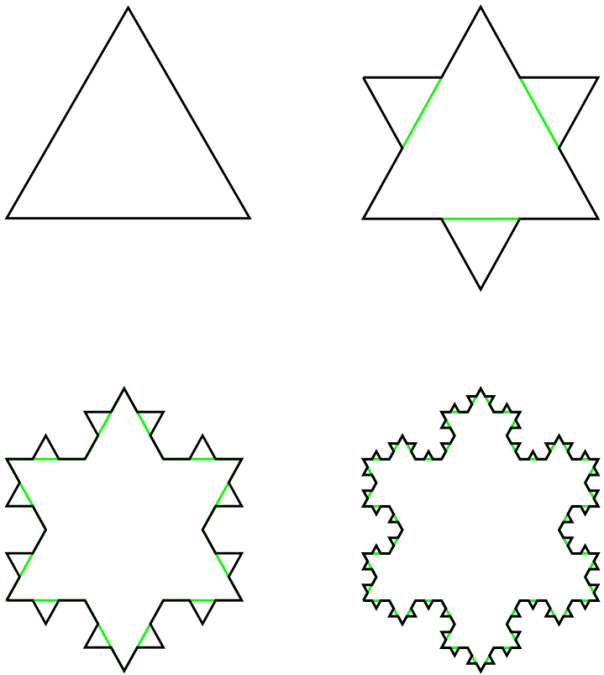
The first four generations of the Koch Snowflake
As the number of generations increases, the area of the snowflake increases, but it increases towards a limit: eight-fifths of the size of the first (triangular) generation. This is because each additional generation adds three triangles which are one-ninth the size of the triangle added in the previous generation (for a total increase of one-third), and the additional of increasingly small triangles has a lesser and lesser effect on the overall area as the number of generations increases.
But as the number of generations increases, the perimeter of the shape continues to grow, without approaching a limit: each generation of the Snowflake has a perimeter which is four-thirds of the previous generation’s perimeter. This is because the additional perimeter added each time is four times one-third of the length of each side, for a total increase of four-thirds, as opposed to the one-third increase in area. Because four-thirds is greater than one, the perimeter tends to infinity, whereas the area (which at one-third is less than one) does not.
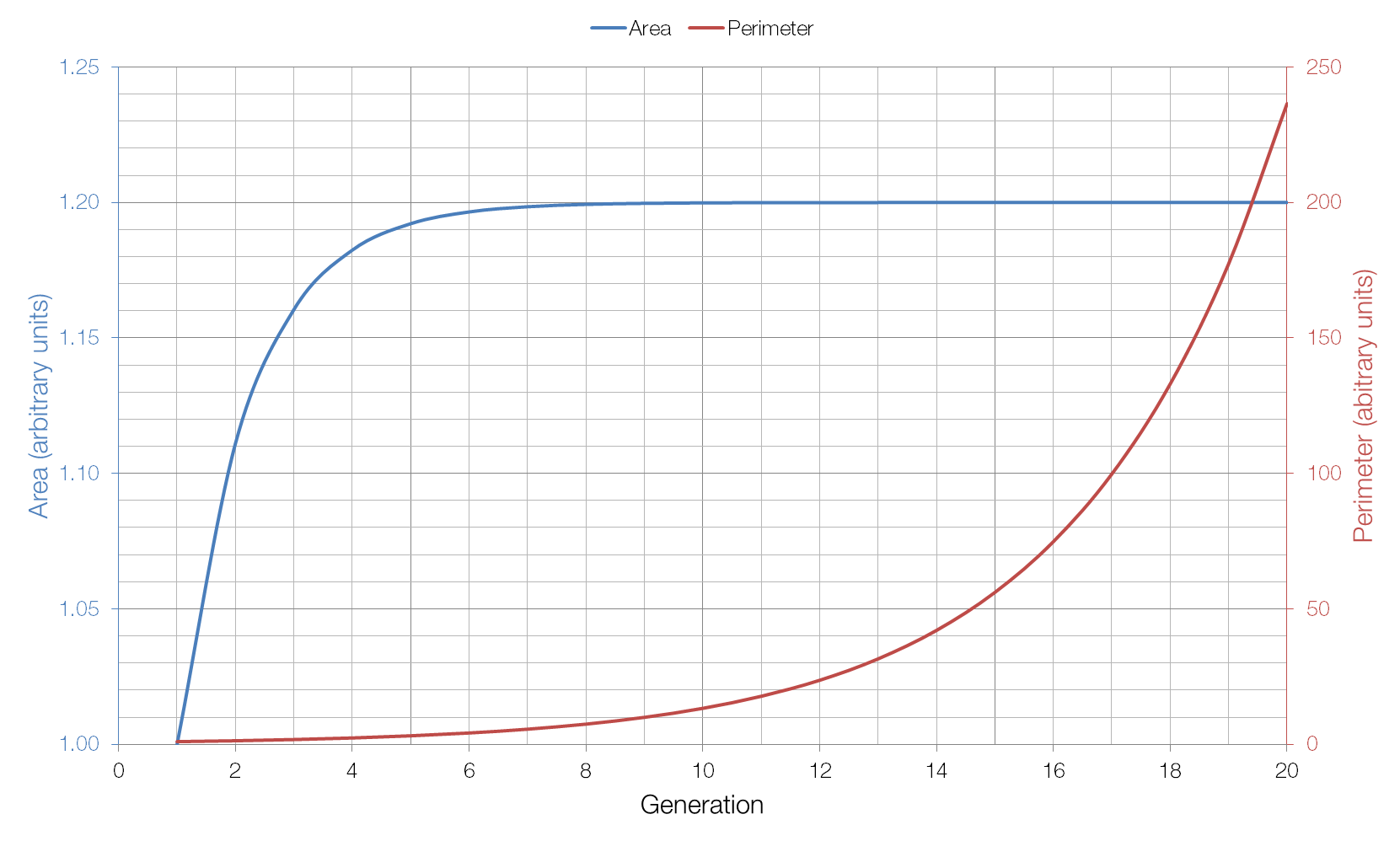
As you can see from the graph above, the area approaches its limit very quickly, whereas the perimeter grows very quickly (which is why it has to be shown on a different axis).