All posts by Mr Reid

Longitude, Latitude and Precision

There are two main ways of giving longitude and latitude: in degrees, minutes and seconds, and in decimal degrees. For example: the current headquarters of the Institute of Physics could be given as 51° 31′ 18.0721″N, 0° 8′ 42.8759″W in degrees, minutes and seconds format; or as 51.521687, -0.145243 in decimal degrees. (Note the absence of cardinal directions in the decimal degrees format: positive latitude values are taken to be north, with negative values being south, and positive longitude values taken to be east, and negative values west.)

Lines of longitude are great circles, each one the same size, running around the Earth and crossing both the north and south poles. When quoting the position of an object on Earth’s surface in terms of its longitude, the degree of precision is not affected by the longitude in question.

Precision Error
1.0° / 1.0° 0′ 0″ ± 111 km
0.1° ± 11.1 km
0° 1′ 0″ ± 1.85 km
0.01° ± 1.11 km
0.001° ± 111 m
0° 0′ 1″ ± 30.9 m
0.0001° ± 11.1 m
0.00001° ± 1.11 m
0.000001° ± 0.111 m

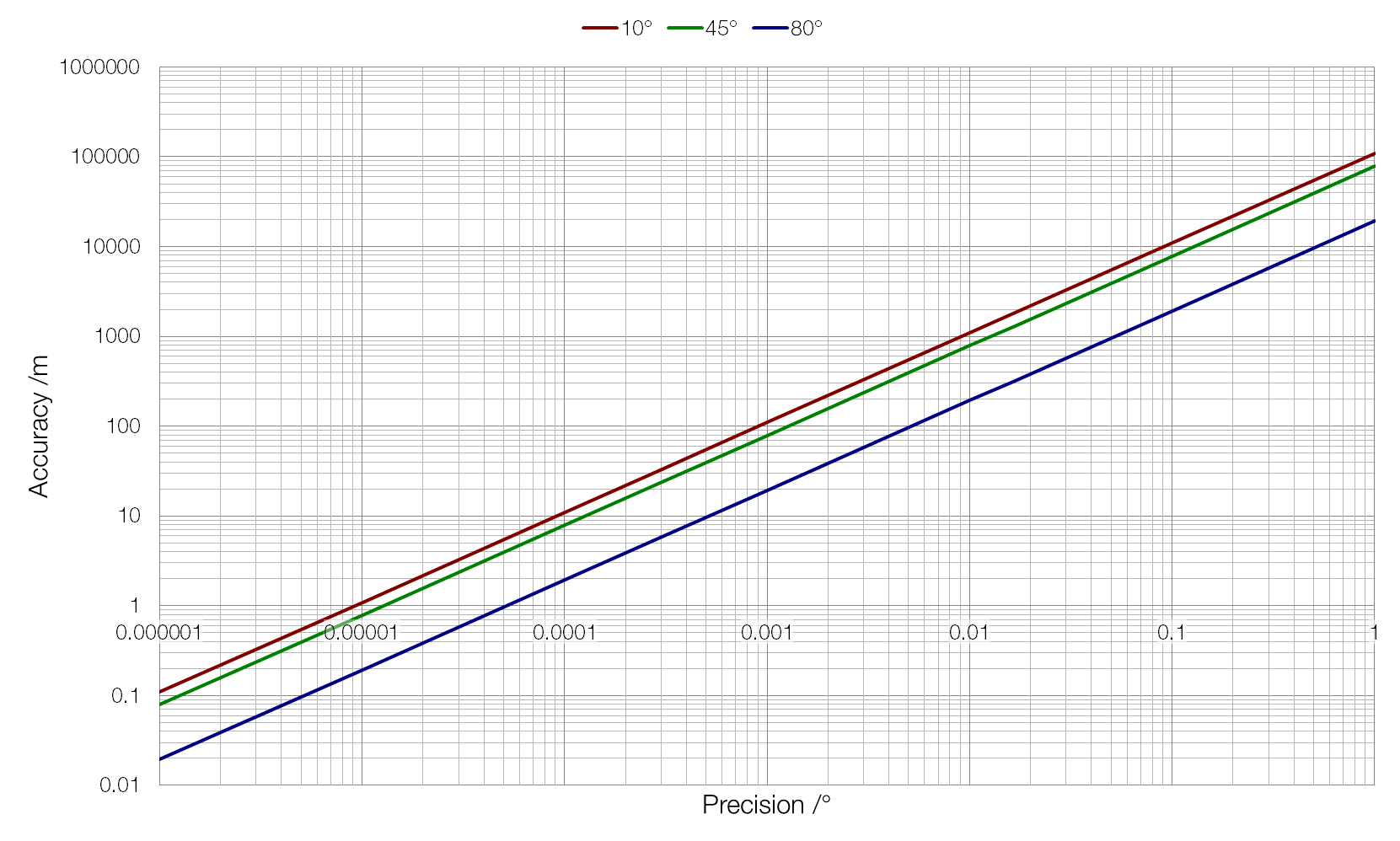
Unlike lines of longitude, not all lines of latitude are the same length. At 80° latitude the length of the line of latitude is only 17.3% of that at the equator. This means that the level of precision changes with latitude – each division of the latitude line is much smaller at you approach the north pole.
latitude-precision

As you can see in the graph above, the change is not linear with latitude. The same 35° difference in latitude yields very different results in terms of accuracy.

This means that different locations will need to use different degrees of accuracy in their GPS coordinates if you want people to be able to find their way around. At Quito, near the equator at 0.23°N, a precision of 0.001° would lead to an accuracy of ± 111 metres, but at Helsinki, much further north at 60.2°N, this accuracy is improved to ± 55 metres.
The Kp Index

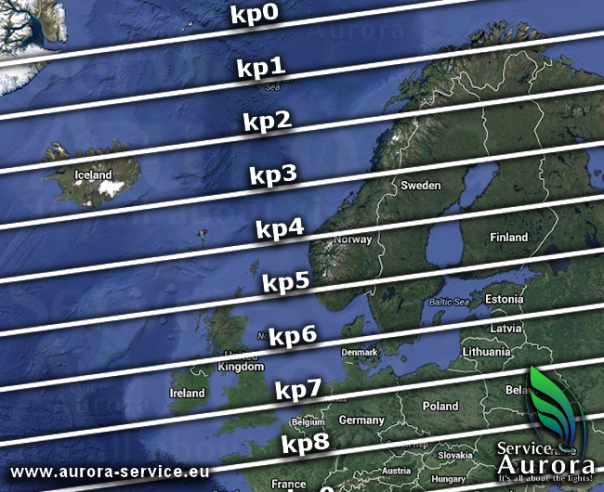
The Kp index is a way of quantifying the level of geomagnetic activity, and the chance of observing the aurora borealis. The higher the Kp index the higher the chance of observing the aurora, and the further south the aurora may be visible.

kpmap

Source

At K= 5 the aurora can be seen from the very north of mainland Scotland, and at K= 7 it can be seen in London (assuming, in both cases, ideal observing conditions).

The Kindex is calculated every three hours by taking the average of the K-index as measured at thirteen different measuring stations. The K-index is a logarithmic scale that measures disturbances of the Earth’s magnetic field caused by solar activity, but it is adjusted so that the regularity of occurrences of each K-index value is the same at each station: that is, the frequency of K= 3 events is the same at Lerwick in Scotland as it is at Witteveen in the Netherlands, even though Lerwick is far more northern than Witteveen.

aurora-australis

The disturbances in the Earth’s magnetic field that the K-index measures are important because it is these disturbances that push the particles into the atmosphere, where they ionise the particles there, causing the emission of light that make up aurorae.

The World’s Longest Golf Shot

concorde

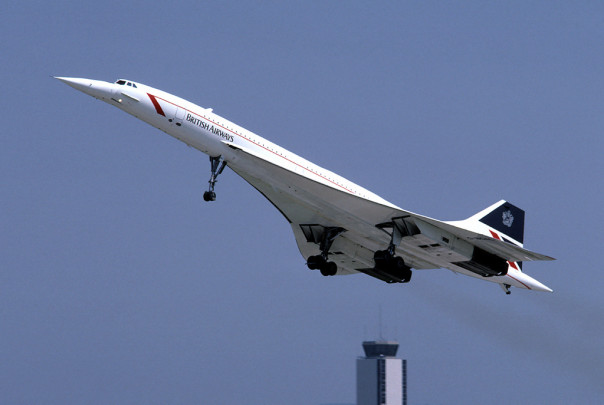
There is a story amongst Concorde pilots about a passenger (or in some versions it’s a pilot or the Flight Engineer) who, when the aeroplane had reached its maximum speed, hit a golf ball from one end of the cabin to the other, performing the longest golf shot in history.

Concorde’s maximum speed was Mach 2.04 or 694 metres per second, and the length of the cabin (from the door of the flight deck to the rear bulkhead) was 39.32 metres. If the golf shot was played at an average speed of 6.5 m/s it would take just over six seconds to travel the length of the fuselage.

The total distance travelled would therefore be 694 m/s multiplied by 6.5 seconds, for a total length travelled of 4200 metres. Adding on the length of the fuselage, and this gives a shot length of 4240 metres, which is 2.6 miles, so I don’t think there’s any doubt that this, if it happened, was certainly the world’s longest golf shot.

Soundex

Soundex is a system for indexing names by sound. It was designed so that homophones, words that sound the same but which are spelt differently, resolve to the same encoding. For example, the names Reid and Reed would both be encoded as R300, McDonald and Macdonald are both M235, etc.

To create a Soundex:

  1. The first letter of the Soundex is the first letter of the name.
  2. Then remove all vowels, and all occurrences of y, h and w.
  3. The remaining letters are encoded one-by-one according to their place of articulation, i.e. where in the mouth or throat the sound is formed.
    1. The labial consonants b, f, p and v, which are formed by the lips, are coded as a one.
    2. The guttural and sibilant consonants, c, g, j, k, q, s, x and z, which are formed at the back of the throat and with the tongue close to the roof of the mouth respectively, are coded as a two.
    3. The dental consonants, d and t, which are formed by the tongue against the teeth are coded as a three.
    4. The long liquid consonant l is encoded as a four.
    5. The nasal consonants, m and n, in which air escapes through the nose, are encoded as a five.
    6. The short liquid consonant r is encoded as a six.
  4. If two letters that are encoded as the same number are next to each other (e.g. the d and t in Schmidt) then the encoding is used only once.
    1. If two letters that are encoded as the same number are separated by a yh or w then the encoding is used only once.
    2. If two letters that are encoded as the same number are separated by a vowel then the encoding is used twice.
  5. The letters are encoded one-by-one until three numbers are produced. If the name is too short, the remainder of the Soundex is encoded using zeroes.

If we use the example of Macdonald from above:

  1. First letter is M.
  2. Removing the vowels leaves us with Mcdnld.
  3. c is encoded as two, giving us M2.
  4. d is encoded as three, giving us M23.
  5. n is encoded as five, giving us M235.

Dot Product and Cross Product

There is more than one way to multiply two numbers together.

Normal everyday multiplication (e.g. 3 \times 4 = 12) isn’t always good enough for physics. If we want to multiply two vectors (quantities that have both size and direction) like force or velocity, then the direction of those vectors matters. The result of a 3 N force multiplied by a 4 N force will depend on their relative directions: if they are pointing in the same direction we will get a different answer to if they are at right angles to each other.

When multiplying two vectors, physicists use one of two products: the dot product or the cross product. Both the moment of a force (the torque) and the work done by a force are calculated by finding the product of a force and a distance, but calculating work done uses the dot product and calculating the moment of a force uses the cross product.

The dot product yields a scalar answer, an answer that does not have a direction. Work done is a scalar quantity, and doesn’t have a direction, hence the use of the dot product. The cross product yields a vector answer, which does have a direction (if you’ve ever used Fleming’s Left Hand rule to find the force acting on a current-carrying wire in a magnetic field you’ve found the cross product of those two vectors). The moment of a force does have a direction, hence the use of the cross product.

Unlike “normal” multiplication and the dot product, the cross product is not commutative, i.e. it matters in which order you multiply quantities. If we find the cross product of  two forces, \mathbf{A} and \mathbf{B} then we will get a different answer to than if we had found the cross product of \mathbf{B} and \mathbf{A} , i.e. \mathbf{A} \times \mathbf{B} \ne \mathbf{B} \times \mathbf{A} . This makes sense when you consider the vector nature of the cross product: a vector to the right multiplied by a vector upwards shouldn’t produce the same result as a vector upwards multiplied by a vector to the right: the result has the same magnitude, but points in a different (opposite) direction.